



Cohen's reversible male contraception research earns recognition at international science summit
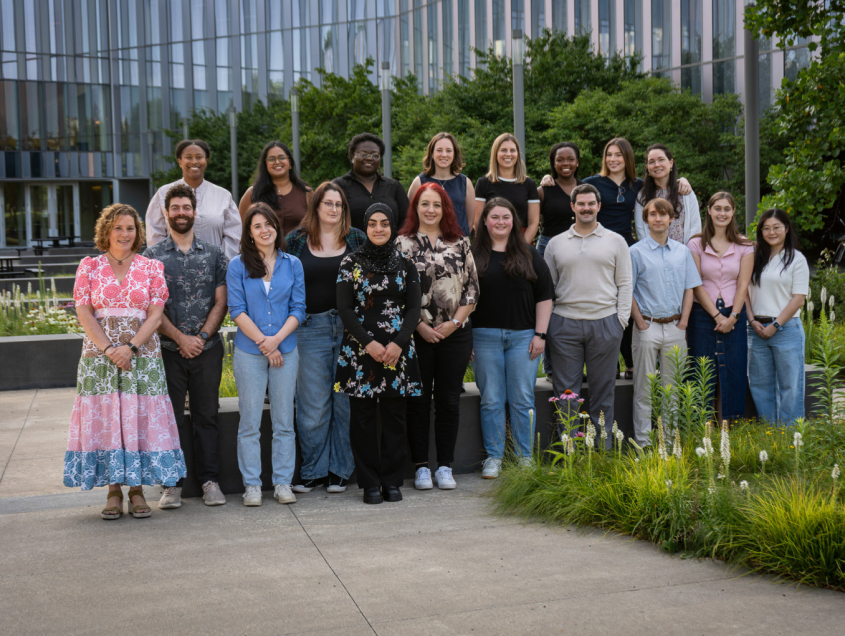
The Cohen lab group. Photo: John Enright/CVM
Dr. Paula Cohen has been chosen as a finalist for the Falling Walls Global Call for Science Breakthroughs 2026. Since 2009, the Falling Walls Science Summit has united the world’s greatest minds to break down barriers in science and innovation.
Cohen's work in reversible male contraception has earned her place as a finalist in the life sciences category. Falling Walls interviewed Cohen on this project recently:
Which wall does your research or project break?
Dr. Cohen’s research breaks the wall of contraceptive inequity: the long-standing assumption that the burden of preventing pregnancy must fall primarily on women. For decades, women have carried most of the physical, hormonal, financial, and social costs of contraception, while men have had few reliable options beyond condoms or vasectomy. This imbalance limits shared responsibility within families and restricts reproductive choice around the world.
Her work challenges the idea that male contraception must be either permanent, hormonally disruptive, or dependent on perfect timing. Many emerging male contraceptive approaches are designed for on-demand use, but coitally timed methods are vulnerable to user error, inconsistent access, negotiation between partners, and failure at the moment when protection is most needed. They also do not solve the need for continuous contraceptive coverage.
Dr. Cohen’s research instead envisions a long-acting, reversible, non-hormonal contraceptive that men could use continuously for 2–4 months at a time, delivered conveniently by injection or patch. This approach would give men a real, sustained role in family planning, while reducing the risk of missed doses, incorrect timing, or inconsistent use. By shifting contraception from a woman-centered responsibility to a shared biological and social responsibility, her work addresses a profound gap in reproductive health.
The wall she seeks to break is therefore not only scientific, but societal: the lack of safe, practical, reversible, and reliable contraceptive options for men. Success would expand reproductive autonomy for individuals and couples, reduce unintended pregnancies, and create a more equitable model of family planning across diverse global settings.