


New faculty profile: Dr. Yana Safonova
The Cornell University College of Veterinary Medicine (CVM) has recently welcomed many new faculty members to our academic departments, each one bringing a unique set of skills and experience that enriches our college every day. In this Q&A series, you'll get to know their interests, expertise and more.
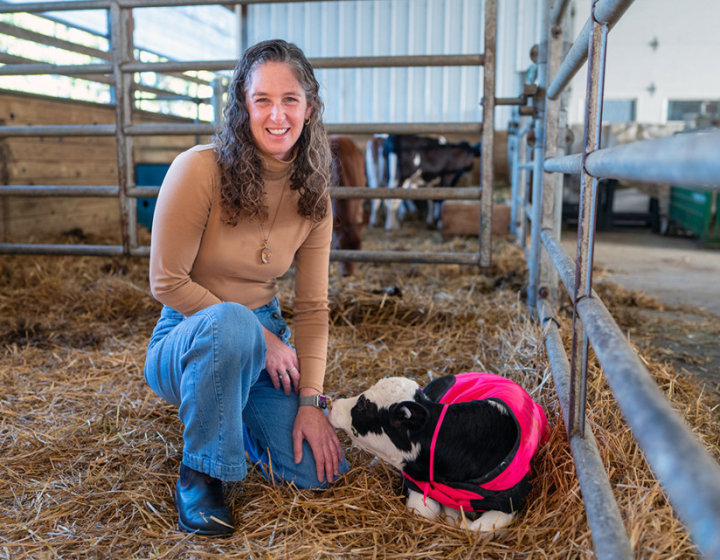
Dr. Yana Safonova, assistant professor at the Baker Institute for Animal Health
Q: What has been your academic and professional journey leading up to Cornell?
My path to Cornell has been shaped by a long-standing interest in using computational biology to understand adaptive immunity. I received my Ph.D. in bioinformatics from St. Petersburg University in Russia, where I worked on computational methods for analyzing complex genomic regions. I then moved to the United States for postdoctoral training at UC San Diego and the University of Louisville, where my work increasingly shifted toward immunology and focused on the extraordinarily complex genes that encode adaptive immunity agents.
I started my independent academic career at Johns Hopkins University, where I focused on applications of my studies to human health, and later moved to Penn State, where I expanded my research program into comparative studies of adaptive immunity across vertebrate species. Over time, I became interested not only in understanding how immune systems evolve and differ, but also in how this knowledge can help us solve practical problems in animal health, species conservation, and human medicine.
That transformation in my research vision ultimately led me to Cornell. The opportunity to join the Baker Institute was especially exciting because it provides an environment where genomics, immunology, veterinary medicine, and animal health can come together. It felt like a natural next step for both my laboratory and the questions we want to pursue.
Q: What attracted you to the CVM and the Baker Institute for Animal Health?
What attracted me most was the opportunity to connect fundamental discoveries in genomics and immunology with real problems in animal health. My laboratory is computational, but many of the questions that motivate us are practical: why are some species particularly susceptible to certain infectious diseases? How has evolution shaped their immune defenses? Can modern biotechnologies help us monitor diseases or improve health management?
The College of Veterinary Medicine and the Baker Institute bring together expertise in immunology, infectious disease, genomics, veterinary medicine, and animal biology in a way that is difficult to find elsewhere. That is one of the most attractive factors: interdisciplinary questions require experts from very different fields. I was also very impressed by the structure and collaborative culture at the Baker Institute. It is small enough for people to know each other and exchange ideas while being part of an enormous research ecosystem of Cornell.
Q: How would you describe your research program to someone outside your field?
Our lab studies adaptive immune systems and immune responses across different species.
All vertebrates, from humans and dogs to birds and fish, have adaptive immunity, a highly specialized defense system capable of recognizing an enormous variety of pathogens, including ones the body has never encountered before. At the heart of this system are two fascinating types of immune proteins: antibodies and T-cell receptors.
What makes these proteins unusual is their extraordinary variability. Each individual can produce an enormous repertoire of diverse antibodies and T-cell receptors, encoded by extremely complex and variable regions of the genome. As a result, every person or animal has a unique immune repertoire. This makes the system powerful and exceptionally difficult to study at the same time.
Our field, computational immunogenomics, brings together genomics, immunology, and data science to study this complexity using modern sequencing technologies. In our lab, we develop computational approaches to characterize immune genes and repertoires across individuals and species and look for patterns associated with different immune responses. Ultimately, we use these patterns to ask questions such as: Why might one species be resistant to a disease while another is vulnerable? Why do some animals respond better to a vaccine than others? And what can the remarkable diversity of immune systems across species teach us about animal and human health?
Q: What originally sparked your interest in this area of research?
I have always been fascinated by biology and biological complexity. During my Ph.D. studies, I started working on genomic regions that were so variable and structurally complicated that conventional computational methods struggled to analyze them. Adaptive immune genes are an extreme example of that problem.
What began as a computational challenge gradually became a biological fascination. Adaptive immune genes are remarkable because evolution has created many different solutions to the same fundamental problem: how to recognize an almost unlimited diversity of pathogens. As we began analyzing more species, I realized that comparative genomics could reveal immune mechanisms that we would never discover by studying humans or traditional laboratory organisms alone. That realization fundamentally shaped my research program.
Q: What discovery, project, or accomplishment are you most proud of so far, and why?
One project that is particularly meaningful to me is our recent work on the black-footed ferret, one of North America's most endangered mammals. Black-footed ferrets are extremely susceptible to plague, a disease caused by Yersinia pestis. Through comparative genomics, we identified an unusual antibody gene that has been conserved across many carnivore species but is disrupted in the black-footed ferret. Our results suggest that antibodies encoded by this gene may interact with the plague bacterium in a way that helps protect other species.
I am proud of this work not only because of the scientific discovery, but because it illustrates what comparative immunogenomics can potentially contribute to conservation. A question that began with comparing genomes across species led us to a hypothesis about why an endangered animal may be vulnerable to a devastating disease. For me, that is exactly the kind of bridge I want our laboratory to build between computational sciences, fundamental immunology, and real-world problems.
Q: How do you hope your research will improve animal health, human health, or our understanding of disease?
Modern sequencing technologies helped us to uncover previously hidden complex genomic regions such ones harboring adaptive immune genes. As these technologies have become more accessible and affordable, we can now study this variation across many individuals and design studies focused on specific diseases, infections, or vaccines. This approach can characterize variation in immune genes and repertoires and reveal features associated with successful or failing immune responses within and across populations. Ultimately, we hope this will help explain why individuals, populations, breeds, or species can respond very differently when facing the same immune challenge.
For veterinary medicine, this could help us understand why particular breeds or species respond differently to infection, vaccination, or other immune challenges. In conservation, it could help identify vulnerabilities in endangered populations and inform genetic rescue or disease-management strategies. In human health, understanding variation in immune responses could reveal why vaccines or therapies work well for some people but not others and help identify opportunities for developing improved interventions. Finally, discoveries in animals can uncover immune mechanisms that have been overlooked in humans and generate entirely new ideas about human health and disease.
Q: The Baker Institute has a long history of advancing animal and human health through discovery. How do you see your work contributing to that mission?
I see comparative immunogenomics as a natural extension of that mission.
Baker has a remarkable tradition of using fundamental biological discoveries to address important problems in animal health. Our laboratory brings a comparative genomic perspective to that effort. We can now generate accurate genomes and adaptive immune repertoires from many species, including animals that historically received very little attention from genomics and immunology. The challenge is to turn this sequence information into biological understanding.
My hope is that our laboratory can help identify previously unknown immune mechanisms, explain differences in disease susceptibility among species and populations, and generate hypotheses that can then be tested experimentally with colleagues at Baker and across Cornell. I am particularly excited about working at the intersection of animal health, infectious disease, comparative biology, and conservation.
Q: What types of partnerships or interdisciplinary collaborations are you most interested in pursuing?
The projects that excite me most are those where computational immunogenomics can be connected directly with experimental biology and veterinary questions. I am very interested in collaborating with immunologists and infectious-disease researchers who can help us experimentally test mechanisms that emerge from our analyses. I also hope to work closely with veterinarians and researchers studying naturally occurring diseases in companion animals, livestock, wildlife and endangered species.
Our previous work has shown us how powerful these interdisciplinary approaches can be. The black-footed ferret project showed us how genomic discoveries can potentially inform conservation decisions, and our work with cattle disease revealed how profiling of immune responses can identify genotypes that are particularly vulnerable to infection. I would like to expand that approach to other species and study cases.
More broadly, I enjoy collaborations where people bring different expertise and work together on problems that are too complex and multifaceted to be solved independently.
Q: As you establish your laboratory, what are you most excited to build, explore or discover over the next few years?
Over the past few years, work by our group and others has revealed exciting associations between variation in complex immune loci and immune phenotypes including differences in disease susceptibility and immune responses. These studies have also made it clear how much remains to be discovered.
What excites me most is the opportunity to make these discoveries more systematic and, eventually, routine. I would like our laboratory to develop computational approaches that can connect variation in immune genes with variation in immune responses across individuals, populations, and species. Rather than studying one gene or one species at a time, we want to build approaches that can identify important patterns at scale.
Ultimately, I hope these methods will become engines for biological discoveries and help to generate hypotheses that can be tested experimentally. My goal is to turn the rapidly growing amount of immunogenomic data into biological knowledge that can advance both animal and human health.
Q: What emerging challenges or opportunities in your field do you believe will shape the future of veterinary research?
One enormous opportunity is the rapid improvement in sequencing technologies. For many years, researchers had excellent genomic resources for humans and a handful of model organisms, while the genomes of many veterinary and wildlife species remained incomplete, including complex regions containing immune genes.
That is changing very quickly. Long-read sequencing and new genome-assembly technologies have already produced highly accurate genomes across the tree of life. Now the genomic field is moving from the concept of a single "reference genome" per species toward understanding genomic diversity at the population or “pangenomic” level. In addition, we can generate additional layers of biological information: which genes are expressed and by which cells, how the genome is modified through DNA methylation, how it is organized in three-dimensional space inside the cell.
The challenge now is interpretation. We are generating biological data faster than we can understand the biological function. I think veterinary research has a tremendous opportunity here because animals represent extraordinary natural diversity in disease susceptibility, lifespan, and adaptation. Combining high-quality genomic information with veterinary knowledge and experimental biology can help us understand what genomic variation actually means and transform it into discoveries that benefit both animals and humans.
Q: What do you enjoy most about mentoring students and trainees?
One of the most rewarding parts of mentoring is watching someone gradually become an independent scientist. Students often begin by asking "What should I do next?". Over time, the questions change. They come saying, "I found something interesting" or "I think we should try this." That transition, from following guidance of your mentor to getting the ownership the problem and gaining a confidence of an expert, is wonderful to watch.
I also enjoy the fact that mentoring is never one-directional. Students bring different backgrounds, ideas, and ways of thinking, and they frequently notice things that I miss. The best scientific discussions happen when everyone feels comfortable sharing ideas and challenging them.
Q: What qualities do you hope to foster in the next generation of scientists?
Curiosity, independence, rigor, resilience and kindness.
I was fortunate to work with mentors who showed me how important these qualities are individually and, more importantly, together. I want my trainees to become comfortable asking questions that do not have obvious answers and working on problems that initially look too difficult. Science inevitably involves failed experiments, messy data, disproved theories, and many, many rejections, so resilience is also extremely important.
At the same time, I think being a good scientist should also mean being a good colleague. I want students to learn to collaborate, give credit, communicate openly, and help people around them. That is why I view having an environment fostering such collaborations as a crucial component of research. I hope they leave my laboratory not simply knowing how to perform a particular analysis but knowing how to identify an interesting scientific problem and having the confidence, skills, and network to pursue it.
Q: What is something people might be surprised to learn about you?
I learned to play the saxophone when I was younger. I don't think I was particularly good at it, but learning an instrument gave me a deep appreciation for jazz and music in general. It taught me to listen to music differently, and it has stayed with me ever since.
Some of my musical interests have also found their way into my scientific life. I have been a Queen fan since I was very young, and learning about Freddie Mercury's life led me to read about HIV/AIDS and want to do HIV research. Eventually I did and learned about CCR5, one of the receptors HIV uses to enter human cells. Years later, CCR5 unexpectedly reappeared in my own research: our work on black-footed ferrets involves unusual antibodies that appear to mimic some features of this receptor.
So, in a very indirect way, there is a line connecting music, immunology, and some of the research my lab does today.
Q: Outside the laboratory, what activities or interests help you recharge and stay inspired?
I love nature, literature, music, and art. I recharge while exploring new places, hiking, watching wildlife, or drawing. Wildlife watching is enjoyable now because it overlaps with my scientific world. It is funny to analyze the beaver genome at work and later encounter its owner on a hike.
Traveling reminds me how large, beautiful and fragile our world is, and how much biological and cultural diversity exists outside the small part of it we see every day. And I am very excited to explore Ithaca and the surroundings. Having the Finger Lakes, gorges, waterfalls, and the Adirondacks nearby feels like a wonderful complement to life at Cornell.
The diversity of animal life is not only something to appreciate and protect — it is also an extraordinary source of scientific knowledge. Every species represents millions of years of evolutionary experiments in surviving infection, adapting to environments, and maintaining health. Modern genomics finally gives us the ability to read much more of that evolutionary record.
By studying immune systems across species, we can uncover new biological mechanisms and potentially use those discoveries to improve veterinary medicine, conservation, and human health. I hope our research helps demonstrate that understanding and protecting animal diversity can also teach us something fundamental about health and disease across all species.