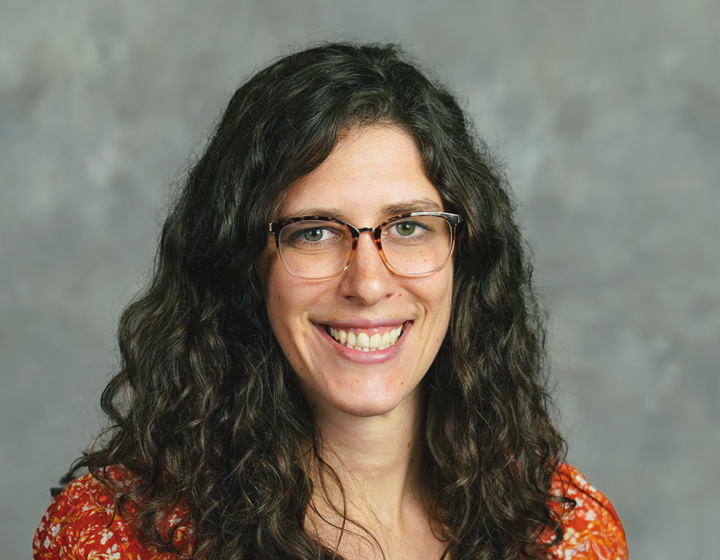


Faculty profile: Dr. Corinna Noel '17
In this Q&A series, get to to know our college faculty's interests, expertise and more.
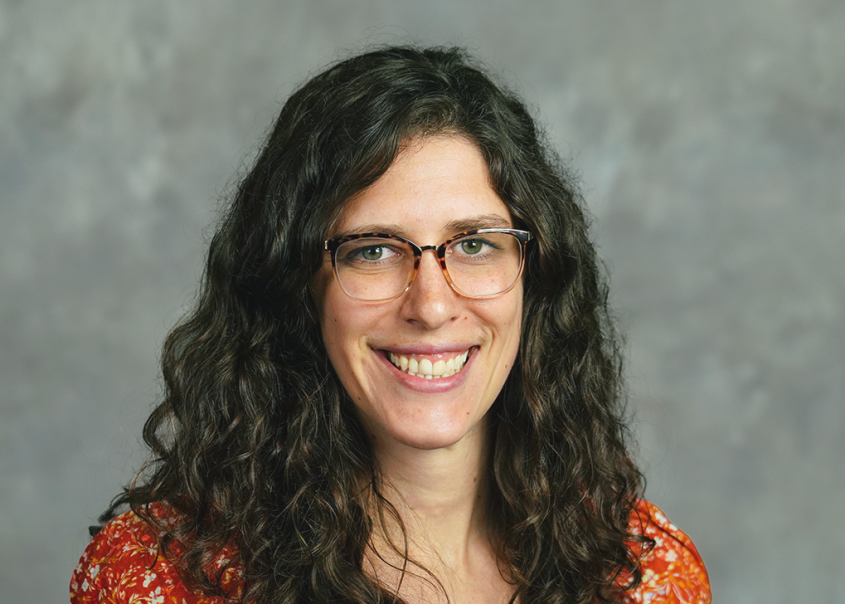
Dr. Corinna Noel '17, assistant professor of practice, Department of Public & Ecosystem Health
Q. What has your academic/career path looked like, and how has your research focus evolved over time?
I've always loved the puzzle of numbers, so I got a BS in Mathematics from Saint Joseph's University in 2013. I then came to Cornell for my PhD in Food Science with minors in Community Nutrition and Epidemiology, which is where I first discovered the field of epidemiology and started thinking about health outcomes at a population level rather than an individual one. Epidemiology gave me a way to combine my quantitative training with public health impact. After my PhD, I did a postdoc in epidemiology at Brown University, then came back to Cornell in 2019 as a Lecturer in the Division of Nutrition, while practicing as an epidemiologist in a local health department. I moved into my current role, Assistant Professor of Practice in the Department of Public and Ecosystem Health at Cornell, in 2022. Over time, my focus has shifted from more traditional nutrition epidemiology toward environmental epidemiology (wildfire smoke, heat) as well as surveillance and community-based evaluation work in mental health, substance use, and healthcare access. Much of that work is in direct partnership with organizations in nearby rural counties, including Tompkins and Cayuga counties.
Q. What drew you to Cornell, and what has kept you here?
The impact-oriented community. It is inspiring to be surrounded by colleagues who are making a difference, and passionate about what they do.
Q. What is your area of expertise?
Practicing epidemiologist who applies quantitative expertise across several areas: environmental epidemiology (wildfire smoke, heat) and community-based surveillance and public health program evaluation (mental health, substance use, access to healthcare and basic needs). I have a special interest in identifying high-need populations and gaps in services at the local level, and I work with a variety of community partners to enhance data-driven decision-making capacity and develop tools to disseminate data effectively.
Q. What experiences, mentors, or influences shaped your path into this area?
I met a wonderful mentor, Dr. Patricia Cassano, the Alan D. Mathios Professor Emerita in the Division of Nutritional Sciences, during graduate school. She introduced me to the field of epidemiology, which started me on my path to where I am today. Many other experiences and people have shaped my experience as well. Come ask me about it!
Q. Looking back, what body of work or accomplishment are you most proud of?
Building out real, functioning data tools for county level public health programs, things like the Cayuga County near real-time overdose surveillance dashboard, where the work doesn't just sit in a paper but actually gets used by the community partners we built it with.
Q. What impacts or applications do you hope to see your work have going forward?
I want the tools and evidence we build to keep informing real decisions in the communities and organizations we partner with, not just add to the literature. I like to focus on enhancing analytic efforts in smaller, rural counties where data capacity is often limited, showing individuals that data and statistics are a vital part of the decision-making process, and using methods in GIS and data science to communicate that effectively. Longer term, I'd like to see our environmental epidemiology work (wildfire smoke and heat) shape how communities prepare for and respond to climate-related hazards.
Q. What's something most people don't know about you?
I have German citizenship and lived in Germany for a year when I was younger. I used to be fluent in German, but now, have sadly lost most of my language skills (or comes out as a mix of German, Spanish, Italian, and English).
Q. What's the best part of your professional work today?
Being able to make a difference! It is so rewarding to work in the public health field in the community that you live. While the work is not always easy, it is motivating to see progress. I also really enjoy working with and mentoring students, in an effort to solve complex, real-world problems.
Q. What's the most challenging part?
Balancing work and life.
Q. What are the benefits of working at CVM? At Cornell?
I am always amazed at the diversity of work being done at the Cornell. Just when you think you have discovered it all, there is always something new to learn and someone new to meet.