



CVM student wins national history essay content
The American Veterinary Medical History Society's annual J. Fred Smithcors Student Veterinary History Essay Contest provides a unique opportunity for veterinary students to learn about the heritage of their new profession by researching and writing about a veterinary history topic of their choice. This year's winner is Cornell D.V.M. student Madeleine Hendell, Class of 2030. Her award-winning essay, shared with permission from the AVMHS, is below.
Medieval marshalcy: Science, magic, and miraculous healing
By Madeleine Hendell
The year is approximately 1250, and you, a learned member of the Court of Frederick the II, have been offered the opportunity to read the newly published Calbriensis Hippiatrica.1 The treatise is written by Jordanus Ruffus [or Giordano Ruffo] (fl. 1200-1256), one of your fellow men at court, and a renowned knight-farrier. Within it, he shares his knowledge of horsemanship, covering topics ranging from standards of care for breeding and exercise, to medical interventions, to the position equine care holds in the rapidly growing world of Western Hippocratic tradition. For him, “it is through the horse that princes, magnates, and kings, can be separated from lesser peoples…”2
In this time period, the social, political, and economic churnings of everyday life are swayed by the soundness of even one animal—most importantly, the horse. The development of medieval marshalcy demonstrates how veterinary medicine developed from an intermingling of practical observation, natural magic, and religious belief before it evolved into a more scientific discipline.
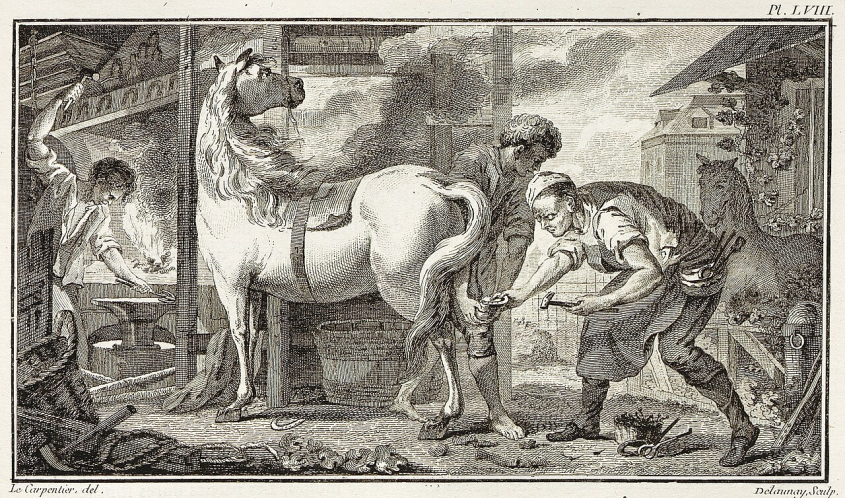
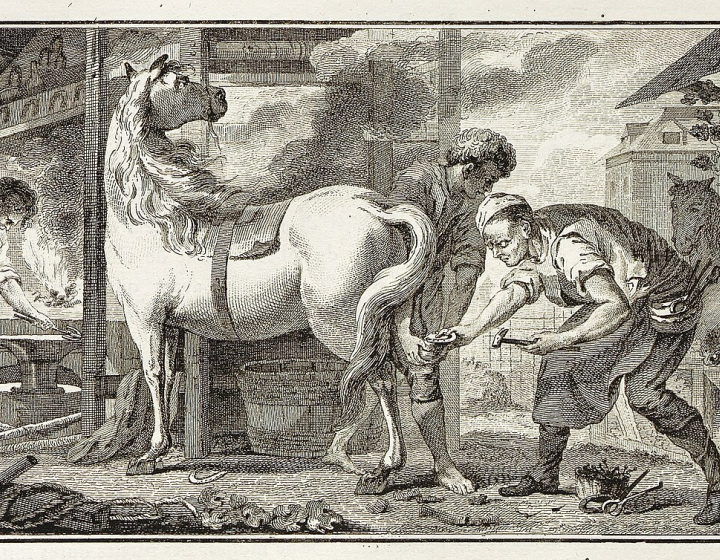
Animals of such importance were valued as both indicators of social status and as well-loved pets, for which nobility was willing to part with not insignificant financial sums. These sums, most often, went to farrier-marshals—those working as precursors to the modern-day equine veterinarian. The term developed gradually, with the founding horse-persons being almost exclusively farriers or marshals, not both. Farriers were stablemasters; keepers of horses, hawks, and hounds for lesser and greater nobles alike. (Fig. 1) Their duties involved shoeing horses and keeping them on strict diet and exercise regimens; they oversaw the breeding and selling of their wards, but doctoring was beyond their skill set. Marshals, on the other hand, focused on the management of equine disease, performing everything from colic treatments to castrations.4
Emergence of the farrier-marshal
In the late Middle Ages, the two careers became muddled. Farriers began to take on more of the clinical treatments needed by their horses, and marshals joined smithing guilds to shoe their patients. Thus, the farrier-marshal was created. As described by Carmel Ferragud, author of The Art of Marshalcy and its Practitioners in the Late Middle Ages, “As happened with the change from barber to barber-surgeon, the incorporation of the term ‘marshal’ was synonymous with economic and social progress.”4 Much of this progress came from the publication of books such as Ruffus’s Calabriensis Hippitrica.
Despite increasing societal understanding of the importance of farrier-marshals, practitioners were limited by their lack of formal medical training, simply because there was no academic course associated with the profession as of yet. Farrier-marshals developed much of their expertise by gaining experience as apprentices and reading the few texts available to them that had been translated from Latin into the spoken language.
Like human clinicians at the time, farrier-marshals followed Galenist practices, espoused by the Roman and Greek physician, surgeon, and philosopher Galen [Galen of Pergamon] (129-c.216 CE), associating illness with an imbalance of one of the four humors.4 As such, it was not impossible for them to plausibly diagnose and treat patients according to the current medical logic, but more often farrier-marshals emphasized preventive regimens. These included the animals’ diet, the state of their stable, and the occasional therapeutic bloodletting.4
Pets in medieval society
The Late Middle Ages brought increasing pressure from the Church to discourage pet ownership. Associated with disease and denoted as one of God’s lesser creations, even the most popular domestic companions, such as cats and dogs, were relegated to the status of pest.5 The horse, of course, was immune to this demotion because of its value, particularly for transportation.
Museum/Maksimile Verlag Luzern. Source.
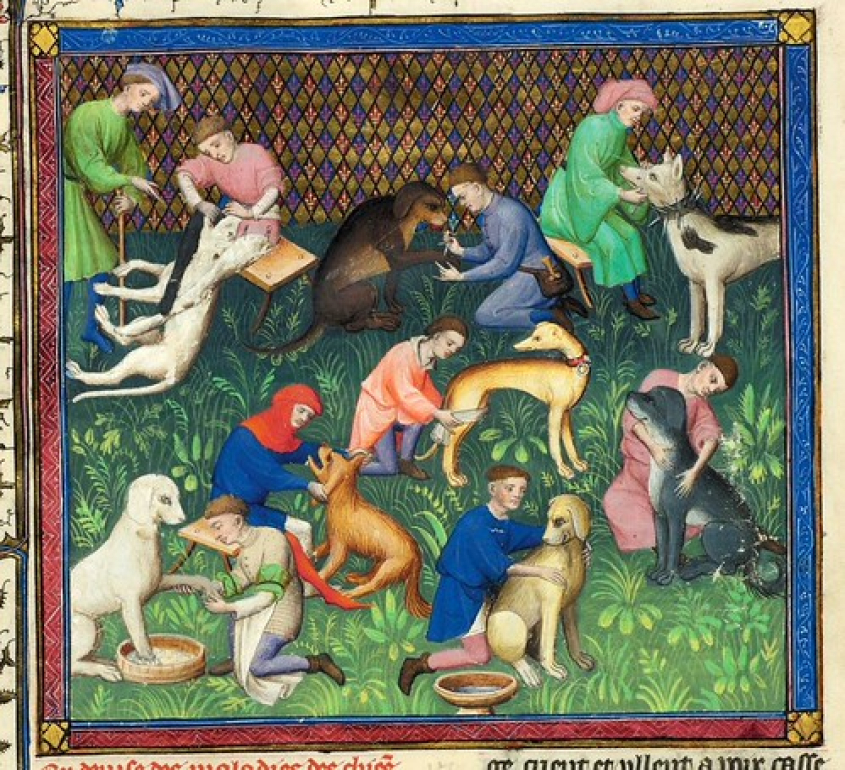
Earlier medieval society, however, held a markedly different view. Those who could afford their care frequently kept animals as companions, and modern distinctions between “pets” and other animals were less rigid. Accounts describe nobles keeping stoats, monkeys, parrots, and squirrels as close companions.6 Even a polar bear was presented to King Henry II in 1252 by the then King of Norway.7 All of this to say, in the High Middle Ages (1000-1300) and Late Middle Ages (1300-1500), pets were an integral part of the culture. With this appreciation for animal companionship, so came the willingness of farmers, sportsmen, and noblemen alike to spend fair coin to pay for their care. (Fig. 2) As a notable example, the 14th century master huntsman Gaston III Phoebus, Count of Foix [Gaston Fébus or Gaston Phébus] (1331-1391), recognized the need for keeping his hunting dogs healthy. He devoted a long chapter on ailments and remedies in his hunting manual Livre de la Chasse [The Book of the Hunt].8 It included advice on proper care and instructions for treating basic wounds and injuries that set a standard for centuries.
This attention to pets aided the legitimacy of marshalcy, further substantiating the career as something worthy of recognition and status. Farrier-marshals rose to moderate rank within their courts, and many began receiving instruction in Latin so that they were able to access medical texts more readily. Apprentices were common, and the catalog of diseases and treatments marshals could reasonably claim to understand was growing.9
Practice of prevention
A farrier-marshal's first line of defense, like that of modern-day veterinarians, was prevention. This took shape in the management of exercise routines, housing, and washing regimens. For example, Laurentius Rusius (1288-1347) describes the moderation required in exercising horses in hot weather, stating that, “...horses should not be ridden between the middle of July and the end of August, as the excessive heat and immoderate labour will dry and desiccate them internally.”3 Similarly, horses “should not be ridden during the coldest months—December and January—as the sweat and excessive heat from their labour would quickly chill them.”3 These practices hold true in modern-day horsemanship, with fans being installed in barns for hot summer days and horses being toweled off after sweating during a winter ride.
In the event these proactive steps should fail, however, marshals had numerous tricks of the trade up their sleeve, although many seem outlandish in light of all we now know about equine medicine. Colic, for example, was thought to have been caused by either an excess of blood or urine. The former, thought to have been caused by swelling of the horse’s veins alone, was solved by bloodletting in near excess. Jordanus Ruffus describes this process, stating that, “...the horse should be bled from their saddle-girth vein… they should be bled from each side, nearly to the point of debilitation to the body.”10 He then describes that horses should be exercised by hand, slowly, and not allowed to eat or drink until recovered.
While no veterinarian educated in the last century would advise bleeding a horse as a treatment for colic, Ruffus’s accounts of treating the affliction do have some kernels of accuracy. His descriptions of colic symptoms, for instance, appear to mirror those seen in modern day horses. Ruffus notes that colic of excess blood can be spotted, “When the horse appears to suffer internally, because they are constantly looking back at their groin and the area around it.”10 These observations, although attributed to causes we now know to be inaccurate, suggest that marshalcy was, to some degree, founded in scientific practice.
Use of “natural magic”
If neither preventive approaches nor the medical interventions that marshals had to offer were effective, it was common practice to turn to “natural magic.” This yielded talismans and charms. Prior to the intervention of the Catholic church in the Late Middle Ages, these solutions were not last-ditch efforts to save a prized animal—they were the gold standard. This natural magic “...centered on the hidden properties of ingredients known to possess potent powers.”6
In this time period, when so little was known, materials like pulverized viper or powdered asphodel were believed to have additional curative properties for ailing animals. Some medical manuals called for these components to be placed around the horse’s neck like an amulet, and others even suggested that sheets of lead and tin be sewn into a horse’s forehead in accordance with medieval alchemical practices.6 These solutions came at no small cost, with most animal owners going directly to a marshal’s workshop and paying in full in cash, although it was not unheard of for installments to be necessary.4
These talismans and amulets were often paired with ritualistic incantations thought to “activate” the magical properties of the materials within them. Although these practices were used for a variety of ailments, the most commonly described is a group of diseases called farcy, glanders, or more generally “the worm.”11 Characterized by weeping pustules across the entirety of the animal’s body, they are described as widely contagious, to both horses and humans, and capable of decimating entire herds.11 As a result, management of afflicted animals was of utmost importance. A common treatment for farcy was tying a caged golden oriole around the horse’s neck; when collecting the bird one was to repeat the pater noster, “replacing the ‘deliver us from evil’ with the horse’s name.”12
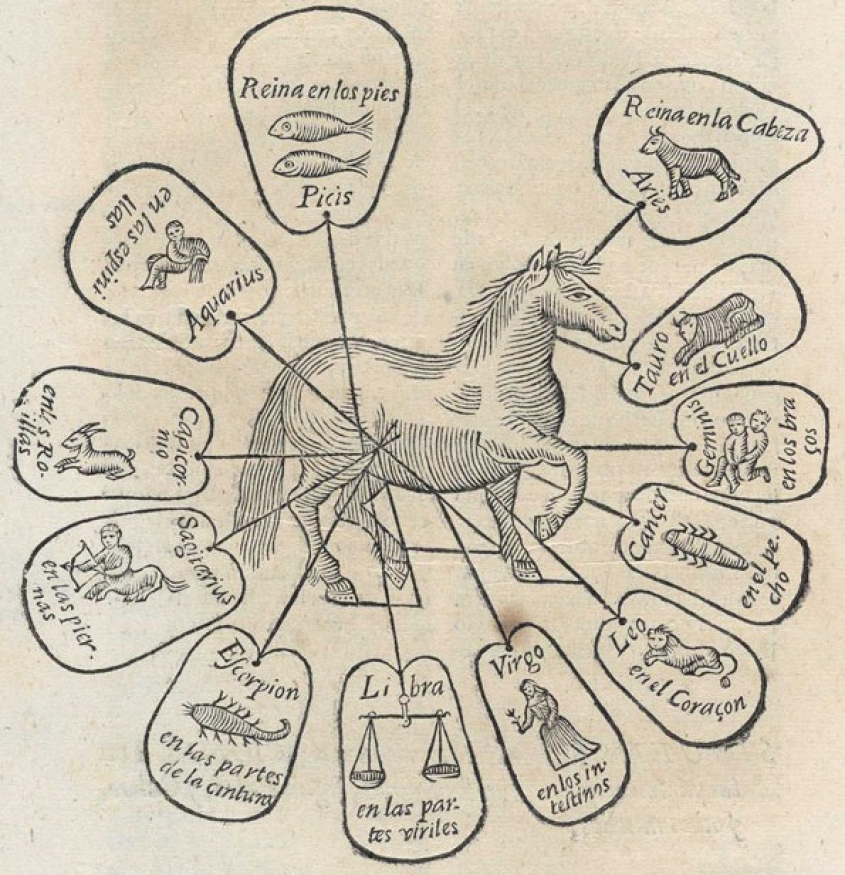
This insistence upon habitual incantation outlines the ritual nature of the practice, cementing the belief in natural magic that was prevalent during the time period. Other incantations were used for the horse that resisted being bridled, and some marshals even called upon diagrams such as the “Zodiac horse” (Fig. 4) to help them determine the best season to orchestrate particular medical interventions.6
Role of patron saints

When all else failed, marshals called on God to save their patients. Patron saints canonically had certain animals associated with their care, with Saint Eligius (588-660) leading the charge as the patron saint of horses, riders, and veterinarians. Other commonly called upon saints included Saint Thomas Becket [Saint Thomas of Canterbury] (1119 or 1120-1170), associated with hawks and other hunting birds, and Saint Hippolytus [Hippolytus of Rome] (c. 165-ca. 235 AD) (Fig. 5), also associated with horses.6
Medieval Christians believed that these saints could intervene on the behalf of ill animals, and that visiting their shrine to pay respects might bring miraculous healing. That certain saints were afforded such legitimacy in their ability to heal animals further supported the miraculous narrative that marshals depended on when their abilities had failed them thus far.
A prime example of this belief in religious intervention is the miraculous healing of Eustace of Powich’s white horse in 1220. As the story goes, the horse was tied in the field to graze throughout the day, and when Eustace returned from his daily tasks he saw the horse’s face had become so swollen and blackened with disease that he could scarcely recognize it. Desperate for a solution, Eustace pulled a penny from his pocket and knelt to the ground, devoting it to St. Wulfstan (ca. 1008-1095), and made the sign of the cross on the horse’s forehead. With each touch of the penny, the swelling decreased until eventually the horse was restored to its peak health and attitude. Eustace described this healing as the blackness “fleeing at the sign of the cross,” a sort of “casting out” of the evil spirit of disease that had so claimed his beast.13 Such miraculous healing was recorded often and served as a relied-upon treatment for horses with unknown or particularly severe illnesses.
Decline of marshalcy popularity
The popularity of marshalcy, particularly practices dependent on natural magic and calling on saints, began to lose popularity as the Catholic church rose in influence. Medieval theologians worried particularly about healing magic completed by women and the uneducated, claiming that, “...if you don’t really know what they [incantations] mean, then you don’t really know what they do…if they work, it’s because you’re calling on demons.”6 Marshals would agree that they were casting demons away, but the church would not be persuaded.
By the end of the Middle Ages, the prevailing belief regarding creation was that God had given domain of all lesser beings to man, ie, that man was above all else and was to remain that way.6 This meant that the formerly exalted status of companion animals was rapidly becoming something more sinister. To associate closely with an animal was to practice witchcraft, and superstition surrounding those who practiced marshalcy with magical elements grew; many of the practices considered normal in the 11th century became taboo by the 16th.
Scientific education and advancements emerge
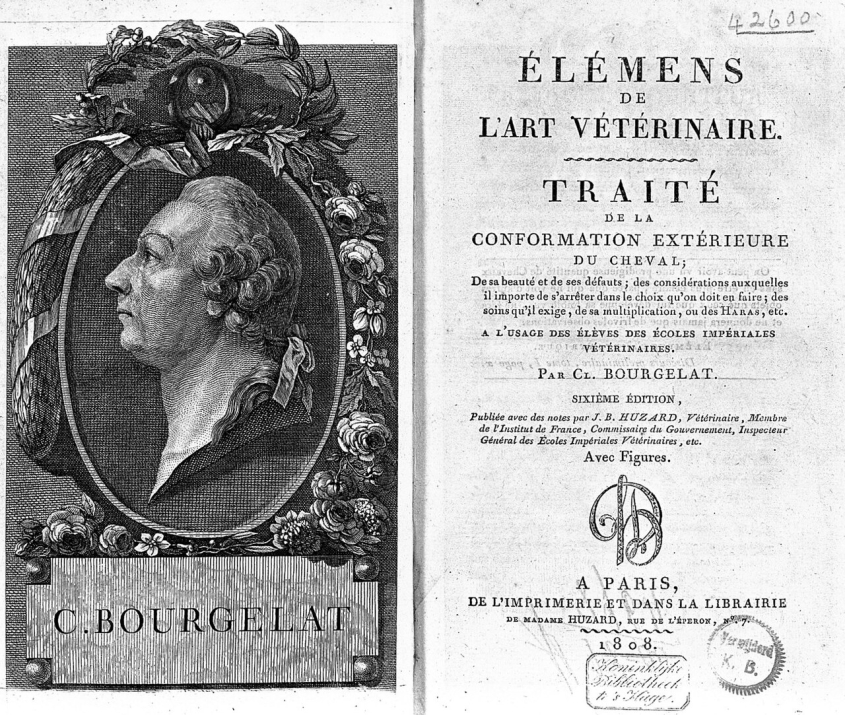
Marshals tucked their more “arcane” knowledge away for a time, working with more traditional remedies to avoid scrutiny. By the 18th century, however, the solution to this issue presented itself in the establishment of formal veterinary schools. The first of these was founded in Lyon, France, in 1761, by equerry and veterinary surgeon Claude Bourgelat (1712-1779). In addition to his texts, such as Elemens de l’Art Veterinaire 14 (Fig. 6), the education centered on horsemanship and equine care, and afforded graduates the same social freedoms of practice as human doctors of the time.15
Veterinary schools began to appear globally in this era, establishing the end of marshalcy and the birth of the veterinary tradition. With this, many of the strange or outlandish ideas surrounding equine care were laid to rest, with scientific advancements establishing the difference between fact and folklore. Although the veterinary profession changed dramatically, its roots in farrier work, marshalcy, and a deep appreciation for the well-being of the animals that serve us has remained ever present.
As the veterinary world continues to advance, it is crucial that we remember these foundational ideas and the people who lived them; it is through their years of trial and error, commitment to animal well-being, and dedication to learning that we continue to grow as culturally aware practitioners.
References
- Ruffus, Jordanus. Jordani Ruffi Calabriensis Hippiatica, ed. by Hieronymus Molin. Padua: s.n., 1818. https://www.digitale-sammlungen.de/en/view/bsb10298721?page=,1
- Harrison S. Jordanus Ruffus and the Late-Medieval Hippiatric Tradition: Animal-care Practitioners and the Horse. Ph.D. Thesis, The University of Leeds, Leeds, Eng, September 2018.
https://www.academia.edu/69407550/Jordanus_Ruffus_and_the_late_medieval_hippiatric_traditi on_Animal_care_practitioners_and_the_horse
(accessed 2026-05-31) - Ibid., p. 196.
- Ferragud C. The art of marshalcy and its practitioners in the Late Middle Ages. Sciencia.cat
(Centre de Documentació Ramon Llull. Universitat de Barcelona), n.d. https://www.sciencia.cat/temes/art-marshalcy-and-its-practitioners-late-middle-ages (accessed 2026-06-01) - Medieval Pet Care. Medievalists.net, n.d. https://www.medievalists.net/2023/11/medieval-pet-care/ (accessed 2026-06-02)
- Last J. The veterinary magic of the Middle Ages: Medieval healers treated animals’ ailments with a mix of faith, tradition and science. Smithsonian Magazine. 2022 Oct 31.
https://www.smithsonianmag.com/history/the-veterinary-magic-of-the-middle-ages-1809 81040 - Bibby M. King Henry III’s polar bear. Historic UK, n.d. https://www.historic-uk.com/CultureUK/Henry-III-Polar-Bear/ (accessed 2026-05-31)
- Gaston III Phoebus, Count of Foix. Livre de la chasse, par Gaston Phébus, comte de Foix. Reproduction réduite des 87 miniatures du Manuscrit français 616 de la Bibliothèque Nationale. Paris: Imprimerie Berthaud frères, Catala frères, succrs, [1909]. HathiTrust Digital Library, https://hdl.handle.net/2027/uiug.3011205301408
- The Farrier’s Company. The Worshipful Company of Farriers traces its origins to 1356. The Worshipful Company of Farriers, n.d. https://www.wcf.org.uk/history/history-overview (accessed 2026-06-03
- Harrison S. Veterinary Medicine in the Later Middle Ages. University of Leeds, Leeds, Eng, 2017; p. 5. (accessed 2026-06-03)
- Medical recipes and charms for horses. Cambridge University Library, MS Dd.4.44, University of Cambridge Creative Commons, https://cudl.lib.cam.ac.uk/view/MS-DD-00004-00044/11 (accessed 2026-06-03)
- Harrison S. ‘Deliver This Horse from Evil’: The ritual aspects of responses to veterinary disease in the Late Middle Ages. Soc Hist Med. 2021 Oct 6;35(2);522–542.
https://doi.org/10.1093/shm/hkab042 https://pmc.ncbi.nlm.nih.gov/articles/PMC9086772/ - Hopler W. Who was Saint Eligius (A parton saint of horses)? Learn Religions. June 25, 2019. https://www.learnreligions.com/saint-eligius-patron-saint-of-horses-124327 (accessed 2026-05-30)
- Bourgelat C. Élémens de l'art vétérinaire. Precis anatomique du corps du cheval ... /par M. Bourgelat. A Paris : chez Vallat-la-Chapelle ..., 1769. HathiTrust Digital Library, https://hdl.handle.net/2027/ucm.5329114474
- Degueurce C. Claude Bourgelat et la création des écoles vétérinaires [Claude Bourgelat and the creation of the first veterinary schools]. Comptes Rendus Biologies. 2012 May;335(5):334–342. https://doi.org/10.1016/j.crvi.2012.02.005


.jpg )
