



David Russell, PhD
William Kaplan Professor of Infection Biology, Emeritus
Department of Microbiology & Immunology
Cornell University College of Veterinary Medicine
C5-109 Veterinary Medical Center
Ithaca, NY 14853
Profile
Research/Clinical Interests
Dr. Russell’s laboratory’s research focuses on the interplay between the macrophage and the intracellular pathogens Mycobacterium tuberculosis (Mtb) and Human Immunodeficiency Virus (HIV).
Tuberculosis: The success of Mtb as a pathogen depends on the ability of the bacterium to survive and persist within the host macrophage. We are actively engaged in studying the behavior of both partners in this intimate relationship. We have developed real-time fluorescent readouts of bacterial fitness and replication and have been exploiting these to identify those host cells most able to limit bacterial growth, and those host cells most permissive for bacterial growth. We have used these reporter strains to probe experimental murine infections to functionally-define the host phagocyte subsets present in the infected lung tissue. These data are used to inform ongoing collaborations looking at cells and tissue from human tuberculosis patents at the Malawi-Liverpool-Wellcome Clinical Research Program in Blantyre, Malawi, and the African Health Research Institute, Durban South Africa.
In addition, we have developed an array of fluorescence-based phenotypic screens for drug discovery. We have a high-throughput screening platform in our BSL3 lab that enables us to interrogate extensive compound libraries against intracellular Mtb and host-directed targets. We have already performed extensive screening and have identified novel bacterial targets and candidate lead compounds active against this bacterium. This work is currently supported by the Mueller Health Foundation.
HIV: In addition to infecting CD4 lymphocytes, HIV also infects macrophages, where it sets up a chronic, long-lived infection capable of generating infectious virus. The lab is studying how human alveolar macrophages respond to HIV and how HIV infection of the macrophage directly influences the ability of the body to control other infections, such as tuberculosis. These human studies are pursued through a collaboration with the Malawi-Liverpool-Wellcome Trust Research Laboratories, Blantyre, Malawi.
The research is supported by grants from the NIAID Institute of the National Institutes of Health, by the Bill and Melinda Gates Foundation, and by the Mueller Health Foundation.
Education
PhD (Imperial College, London University)
Biography/Professional Experience
Dr. Russell assumed his position as Professor and Chair of the Department of Microbiology and Immunology in July 2000. He stepped down from his Chair's position in 2010 and now concentrates on his research work. His previous experience was as professor in the Department of Molecular Microbiology at Washington University School of Medicine, in St. Louis, where he had worked since 1990. He received a B.Sc. degree in Zoology from St. Andrews University in Scotland in 1979 and was awarded a Ph.D. from Imperial College, London University in 1982. He has held positions at the University of Kent, the Max-Planck-Institute in Tuebingen, and NYU School of Medicine prior to moving to St. Louis. His research program continues to be supported by funding from the National Institutes of Health for research into the biology of Mycobacterium and the role of the macrophage in infection.
Professional/Academic Affiliations
Dr. Russell is a member of the following Graduate Fields:
Publications
Selected Publications
- Sturgill-Koszycki S, Schlesinger PH, Chakraborty P, Haddix PL, Collins HL, Fok AK, Allen RD, Gluck SL, Heuser J, Russell DG. Lack of acidification in Mycobacterium phagosomes produced by exclusion of the vesicular proton-ATPase. Science. 1994;263(5147):678-81.
- McKinney JD, Honer zu Bentrup K, Munoz-Elias EJ, Miczak A, Chen B, Chan WT, Swenson D, Sacchettini JC, Jacobs WR, Jr., Russell DG. Persistence of Mycobacterium tuberculosis in macrophages and mice requires the glyoxylate shunt enzyme isocitrate lyase. Nature. 2000;406(6797):735-8.
- Kim MJ, Wainwright HC, Locketz M, Bekker LG, Walther GB, Dittrich C, Visser A, Wang W, Hsu FF, Wiehart U, Tsenova L, Kaplan G, Russell DG. Caseation of human tuberculosis granulomas correlates with elevated host lipid metabolism. EMBO Mol Med. 2010;2(7):258-74; PMC2913288.
- Huang L, Nazarova EV, Tan S, Liu Y, Russell DG. Growth of Mycobacterium tuberculosis in vivo segregates with host macrophage metabolism and ontogeny. J Exp Med. 2018;215(4):1135-52; PMC5881470.
- Pisu D, Huang L, Narang V, Theriault M, Le-Bury G, Lee B, Lakudzala AE, Mzinza DT, Mhango DV, Mitini-Nkhoma SC, Jambo KC, Singhal A, Mwandumba HC, Russell DG. Single cell analysis of M. tuberculosis phenotype and macrophage lineages in the infected lung. J Exp Med. 2021;218(9); PMC8302446.
- Simwela NV, Johnston L, Bitar PP, Jaecklein E, Altier C, Sassetti CM, Russell DG. Genome-wide screen of Mycobacterium tuberculosis-infected macrophages revealed GID/CTLH complex-mediated modulation of bacterial growth. Nat Commun. 2024;15(1):9322; PMC11522665.
Link to all publications
See all publicationsAdditional Information
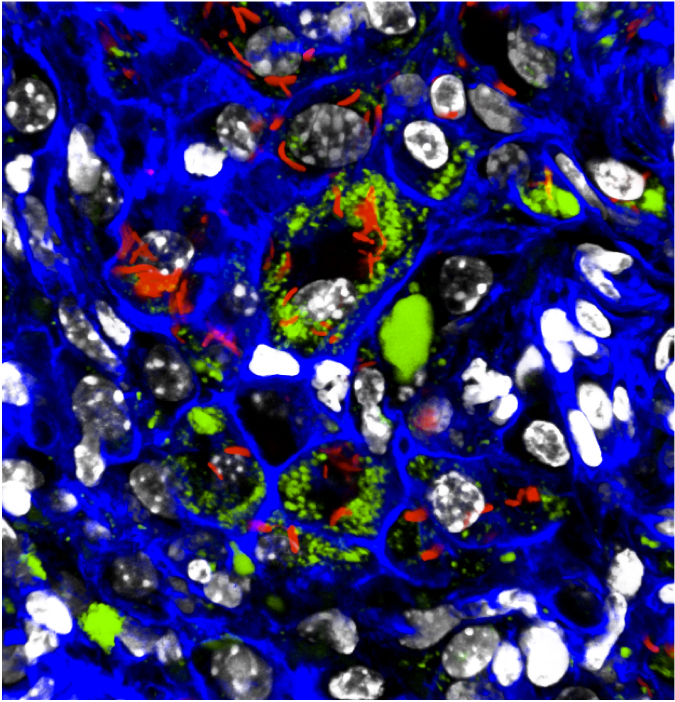
Mtb in a Mouse Lung
One of the goals of my laboratory is to train students and post-docs to think independently and to develop their own research identity. Post-Docs leaving the lab for independent faculty positions take their projects with them and are encouraged to write for bridging awards to accelerate their development.