
Dr. Nicole Buote appointed next director of the Cornell Richard P. Riney Canine Health Center
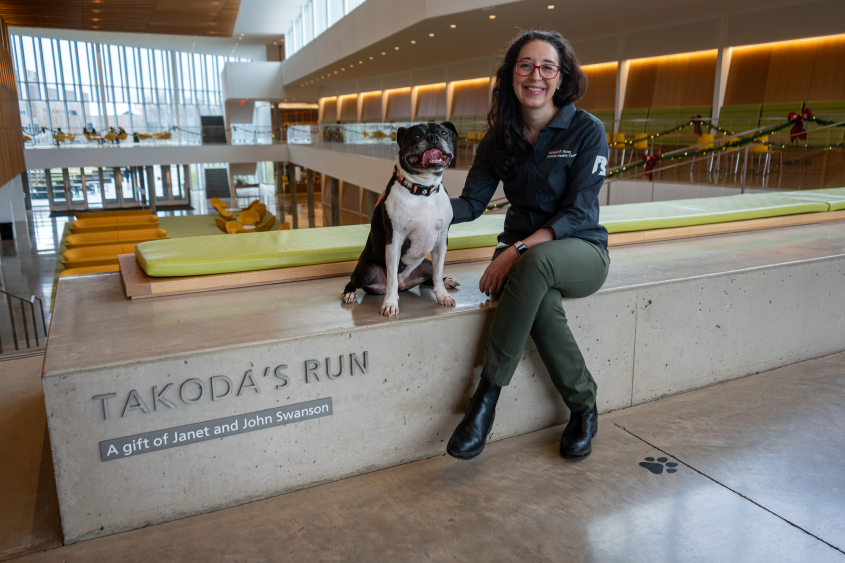
Dr. Nicole Buote, associate professor of small animal surgery in the Department of Clinical Sciences, recently started her tenure as director of the Cornell Richard P. Riney Canine Health Center (RCHC). Buote is the second director in the center’s history following the planned retirement of Rory Todhunter, Ph.D. ’92, professor of surgery in the Department of Clinical Sciences, and inaugural director of RCHC since July 2023.
"Buote’s leadership, vision, and expertise make her an exceptional candidate to continue to lead the growth and success that the RCHC has experienced since its launch in 2021," says Lorin D. Warnick, D.V.M., Ph.D. ’94, the Austin O. Hooey Dean of Veterinary Medicine. "We also extend our sincere appreciation to Dr. Todhunter for his service as director and his work to bring the vision and goals of the RCHC to life."
Since its inception in late 2021, the Cornell Riney Canine Health Center has awarded over $3.1 million in internal grant funding and dedicated $1.3 million in equipment grants in collaboration with the Cornell University Hospital for Animals (CUHA). The center is comprised of over 50 experts spread across the Cornell University College of Veterinary Medicine (CVM), including clinicians and researchers in a wide variety of fields.
Buote joined CVM in 2020 as associate professor of small animal surgery after working in a specialty private practice for 11 years, where she established the Minimally Invasive and Interventional Radiology service. Buote received her D.V.M. from Tufts University Cummings School of Veterinary Medicine, and completed a rotating (Angell Animal Medical Center, Boston) and surgery internship (Dallas Veterinary Surgery Center) before completing a surgery residency at the Animal Medical Center in New York City.
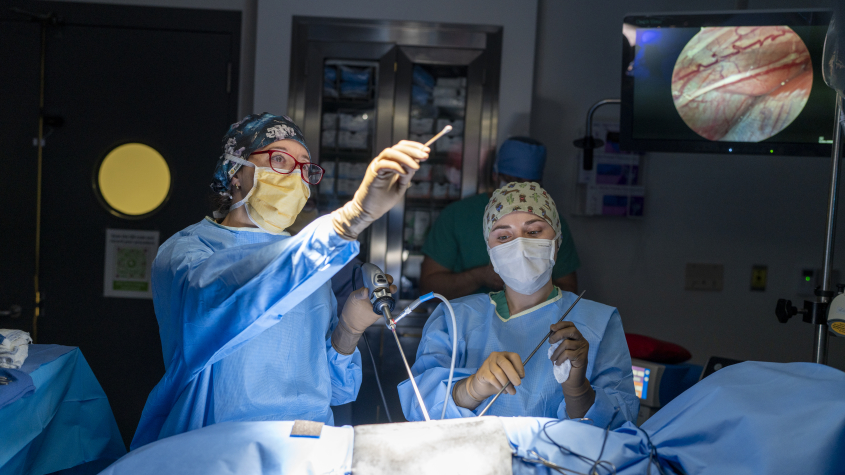
Her previous research primarily focused on soft tissue diseases (biliary re-routing procedures, vacuum assisted open abdomen techniques, leech therapy for reconstructive techniques and intestinal surgery). Since joining Cornell, Buote has investigated and promoted minimally invasive surgery (MIS) and interventional radiologic techniques for animals, including the use of surgical robotics.
She is a Diplomate of the American College of Veterinary Surgeons, an ACVS Founding Fellow of Minimally Invasive Surgery (Soft Tissue) and the founder of the Association of Women Veterinary Surgeons.
“Recognition must be given to Drs. Todhunter and David Lee [associate dean for external programs] for their amazing vision and leadership in launching the Riney Canine Health Center,” says Buote. “In just three years, the center has accomplished an extraordinary amount, including funding innovative research performed by Cornell's clinicians and scientists, solidifying relationships between Cornell and the dog-loving community and creating a reliable web-based knowledge source. These achievements are a testament not only to their guidance, but also to the dedication and tireless work of the entire Riney Canine Health Center staff that brings these programs to life every day with their commitment and energy.”
Buote recently sat down for a Q&A on her background, her commitment to canine health and her goals for the Cornell Riney Canine Health Center.
Q: What inspired you to take on the role of director of the Riney Canine Health Center?
I was drawn to this role by the opportunity to shape the future of canine health care in a way that combines cutting-edge medicine, compassionate clinical care and meaningful research. I believe strongly in collaboration — bringing together specialty clinicians, general practitioners, researchers, and dog owners — to push forward what’s possible for dogs’ health and welfare. The chance to lead the center at this juncture felt like a call to help continue to build something that can offer real impact for patients, their families, and the broader community.
Q: How will your clinical background guide your vision for the center?
My background is in minimally invasive surgery (MIS) and interventional radiology (IR), fields where progress means less pain, faster recovery, and better quality of life for patients. I’ve seen firsthand how MIS can transform outcomes — from spays and gastropexies to complex thoracic and abdominal surgeries. That clinical experience keeps me grounded in what matters most to pet owners and their dogs, and it shapes the kinds of questions I think are important to pursue.
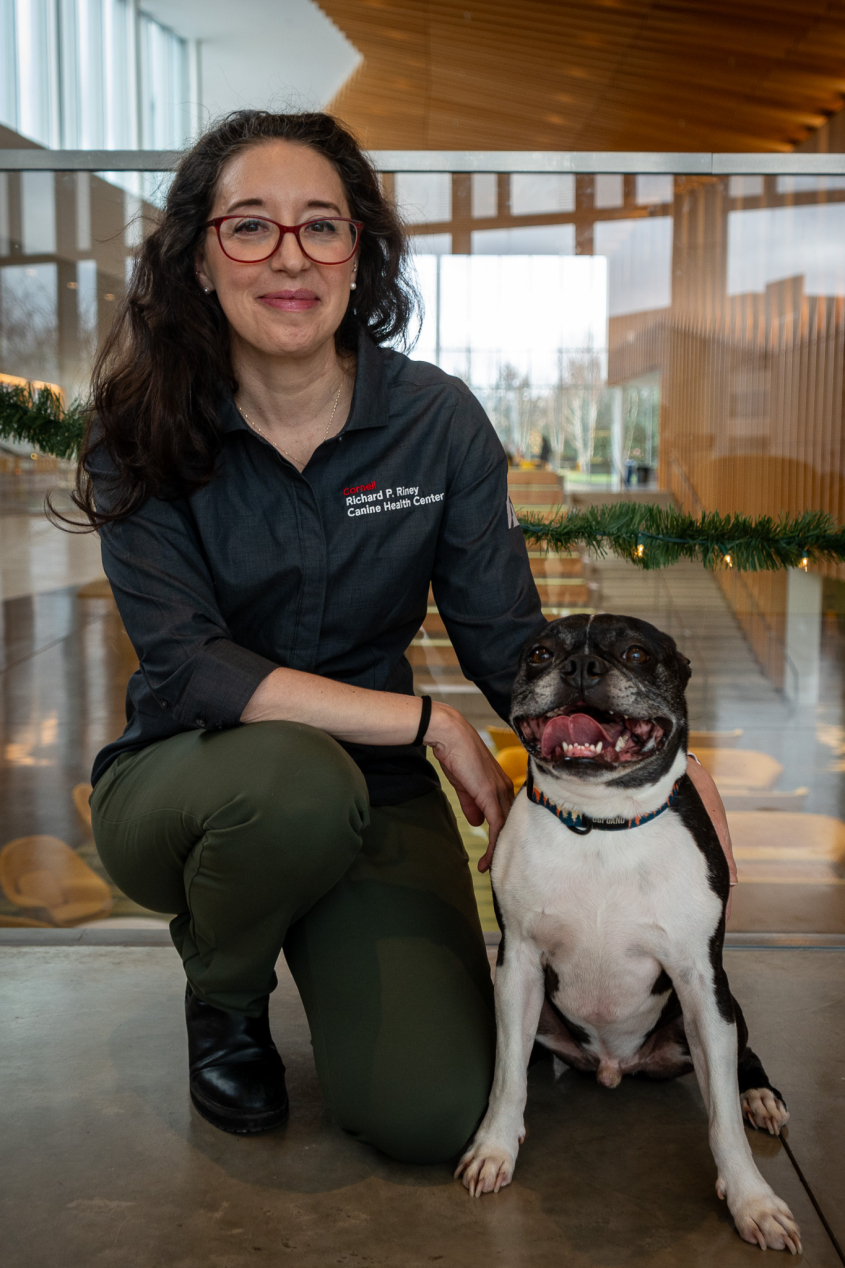
At the same time, my work in collaborative research has shown me the value of the entire scientific process — from basic discovery to clinical application and partnerships with industry. My goal is to bring these perspectives together at the RCHC, supporting research that is both scientifically rigorous and directly meaningful to the families we serve.
Q: What research and clinical innovations are you most excited to explore?
I’m especially interested in continuing to expand minimally invasive surgery (MIS) and exploring how surgical robotics might fit into veterinary care. Robotics has the potential to enhance precision and control, which could benefit patients undergoing both soft-tissue and orthopedic procedures. I’m also looking forward to building clinically-driven research projects that focus on practical, real-world questions, such as early cancer diagnosis and treatments, and metabolic diseases. I plan on taking advantage of the many resources and collaborations available at Cornell across our multiple campuses.
Ultimately, I hope to contribute to steady, meaningful progress — helping identify new approaches, refine existing treatments and uncover answers that can improve the care we provide to dogs.
Q: The RCHC brings together researchers, clinicians and dog owners. How do you hope to strengthen these collaborations during your tenure?
I see the RCHC as a place where different perspectives naturally come together, and I want to strengthen those connections even further. One of my priorities is to help researchers from different disciplines find each other — creating more opportunities for collaboration between basic scientists, clinicians, and those working directly with canine patients. I also plan to spend time listening to dog owners, breeders and referring veterinarians to understand where the gaps in treatment and knowledge truly are.
Their experiences help guide the kinds of questions we should be asking. By building these relationships and fostering communication, we can generate research that is both scientifically meaningful and clinically relevant. Ultimately, I hope to elevate the center’s visibility on a national scale, because the stronger our network and recognition become, the more dogs and families we’ll be able to support.
Q: How do you envision expanding the center’s outreach to dog owners, breeders and referring veterinarians?
I want the RCHC to feel like a true partner to the dog-loving community. Part of that means expanding our educational outreach — through seminars, accessible resources, and small-group or one-on-one conversations with owners and breeders — so people feel informed about treatment options and current research. For referring veterinarians, I hope to strengthen our referral networks and continuing-education efforts, making it easy for general practitioners to collaborate with us on both patient care and clinical trials. Clear channels for consultation and up-to-date information on medical and surgical best practices will be a priority. Ultimately, I want the Cornell Riney Canine Health Center to be recognized not only for strong research, but for meaningful partnerships, open communication and a shared commitment to improving the lives of dogs.
Q: What message would you like to share with the dog-loving community and supporters of the center as you step into this position?
To our community and supporters — thank you for your trust, your passion for dogs, and your belief in what the RCHC can achieve. I’m honored to step into this role, and I’m committed to supporting the clinicians, researchers, and dedicated staff who work every day to improve canine health. My goal is to help foster the collaborations and innovations that lead to better treatments and better outcomes for our patients. Together, we can continue to make a meaningful difference for dogs and their families, offering care, knowledge and hope for healthier lives.