
2026 State of the College address highlights growth, preparing for the future
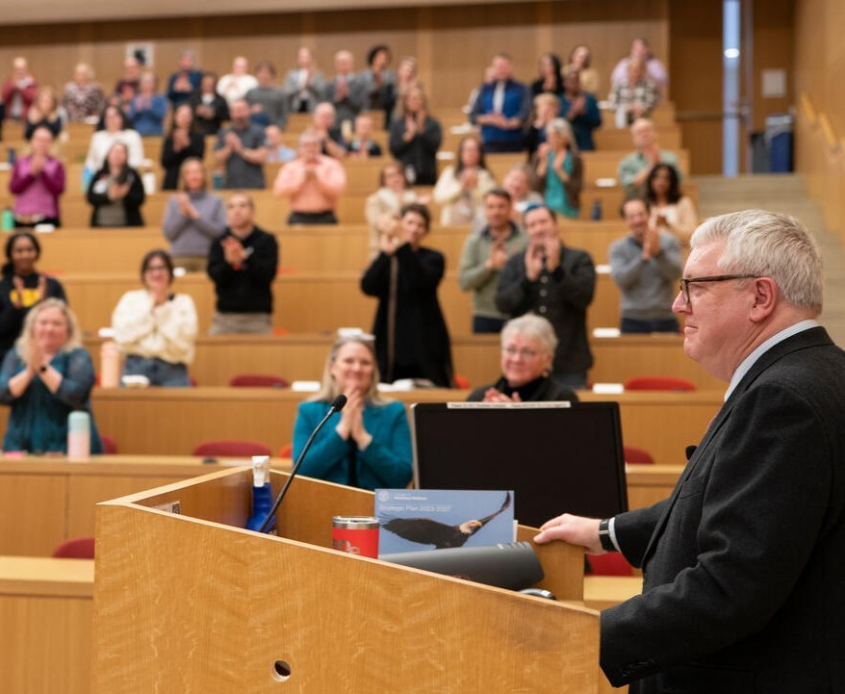
Dean Lorin Warnick receives a standing ovation at his 2026 State of the College address. Photo: Carol Jennings/CVM
On March 24, 2026, Lorin D. Warnick, D.V.M., Ph.D. ’94, the Austin O. Hooey Dean of Veterinary Medicine, gave his annual State of the College address. As he approaches the end of his second term as dean, he reflected on a decade of progress at the College of Veterinary Medicine and while also outlining current financial realities, facility investments, leadership transitions and emerging technologies shaping the college’s next chapter.
Warnick opened by thanking faculty, staff, students, alumni, donors and New York state partners for their efforts supporting the college’s mission, noting that collective effort has enabled meaningful advancement despite significant disruption across higher education, public health and research. “We’ve made important progress and had a positive impact in the world in the face of significant adversity,” he said. “My main message is appreciation for all of you.”
Addressing finances, Warnick also discussed the college’s engagement in Resilient Cornell, a university-wide effort focused on long-term financial sustainability. He acknowledged ongoing uncertainty driven by regarding federal research support and other revenue sources, while citing that philanthropy continues to be a critical offset, with the college more than doubling its $125 million goal in the university’s To Do the Greatest Good campaign. “Gifts large and small are accelerating our work in research, education and clinical care,” Warnick said.
The dean highlighted significant growth across clinical and diagnostic programs, paired with major facility investments. The Cornell University Hospital for Animals is projected to exceed 40,000 patient visits this year, while Cornell University Veterinary Specialists — now celebrating its 15th anniversary — surpasses 30,000 client visits annually. Facility updates include a new linear accelerator, expanded imaging capacity and state-supported expansion at the Animal Health Diagnostic Center.
Warnick also pointed to leadership transitions and organizational changes supporting future growth, including new leadership at Cornell Equine and the Riney Canine Health Center, and the creation of the Department of Biomedical and Translational Sciences.
The dean also highlighted steady advancement toward the college’s 2023–2027 strategic goals, which build on accomplishments from the previous planning cycle. Among the year’s key developments were continued growth in educational programs, including new concentrations in the M.P.H. program and progress on the D.V.M. curriculum redesign, sharing that pilot projects have been well-received and show “positive outcomes for both students and faculty.” He also noted the rapid advancement in AI efforts, including faculty-led governance, pilot research applications and educational programming. Warnick emphasized the importance of thoughtful engagement with new technologies, while preserving the college’s hands-on, collaborative culture. He noted appreciation for the college's alumni and friends who helped advance these strategic goals by contributing to the university's To Do the Greatest Good campaign.
Warnick reflected on what he has enjoyed most during his tenure: the variety and purpose of the work. “Clinical care, public health and biomedical research all matter deeply,” he said. “But what I’ve valued most is the people — working across disciplines, time scales and settings with a community that is deeply committed to making a difference.”
Warnick closed by expressing confidence in the college’s future and gratitude for the opportunity to serve as dean. “This is a terrific, capable community,” he said. “I’m proud of what we accomplish together and optimistic about where we’re headed.”
Written by Elodie Smith