
A win-win: Scholarship gift emerges from Qualified Charitable Distribution
Creating a D.V.M. scholarship may feel out of reach for most of us — giving away large dollar amounts that are meant to make a significant difference for a professional student is no small financial feat. But, for folks with a reasonable retirement account, making this kind of impact is more feasible than most people think.
Take Mia Stone Simpson, MBA ’08, who was able to establish the Simstone Go Forward 2 scholarship at the Cornell University College of Veterinary Medicine (CVM) through relatively simple financial methods that benefited both her long-term finances and the veterinary students who received the funding.
To do this, Simpson took a Qualified Charitable Distribution (QCD) from her individual retirement account (IRA). “I requested Cornell Veterinary School to award the entire amount between two students,” says Simpson. “I did not need the money in my IRA nor did I want the future tax implications of a required distribution — taking the charitable distribution made sense to do.”
People 73 and older who hold IRAs, are required to withdraw a certain percentage from the account each year — this is called a required minimum distribution, or RMD. When someone withdraws that amount, it increases their total taxable income, thus potentially pushing people into higher income tax brackets and increasing the taxable portion of their Social Security benefits or Medicare premiums. For people who are seventy-and-a-half years or older, like Simpson, they may transfer up to $111,000 each year from an IRA account to a qualified charity, thus avoiding higher taxes.
On top of these personal benefits, QCD’s are a win-win solution to some of the issues mentioned above and enable significant philanthropy. Simpson wanted her distribution to make a difference in someone’s life at Cornell, and concluded that a scholarship for Cornell veterinary students was the best way to do that.
Simpson had her own connection to the animal health world; “One of my first jobs in California was at a veterinary practice,” she says. “After a couple years there, I took the registered animal health technician exam and fortunately passed becoming one of the first to do so.”
While she would later shift from being an LVT to working in financial asset management, that connection to animal health and care clearly continued. Simpson had several horses when she was young, riding competitively in cross country jumping and dressage, and has always had dogs. After becoming an LVT, she started working at a company training personal protection dogs as their business manager and veterinary consult. “This was long before the days of cell phones and security cameras,” Simpson says, noting that the protection dogs were trained to provide security for families and executives.
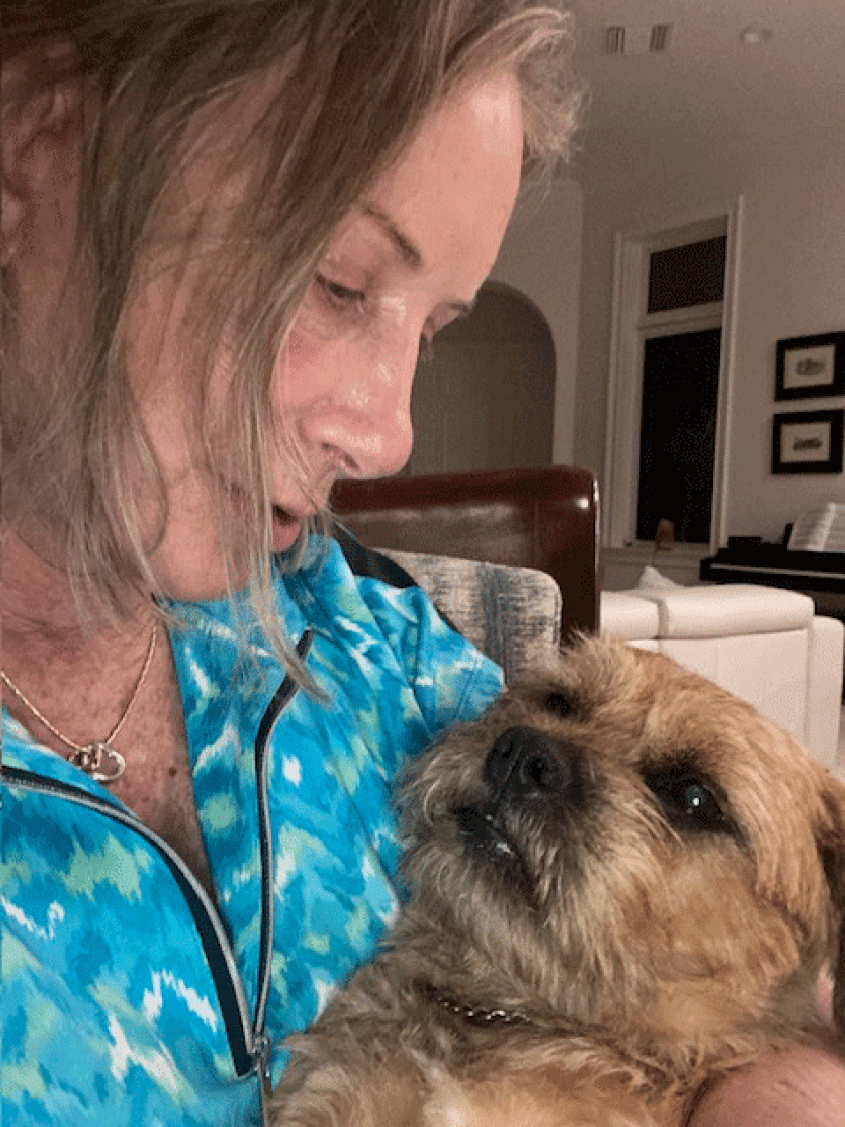
Simpson later ended up in Connecticut and transferred her business skills from dogs to becoming the office manager for a small asset management company. From there, she stayed with asset management for the rest of her career, working on Wall Street and at GE Asset Management. Today, she is retired and has a Border Terrier “who runs the house.”
Simpson’s hard work over the years has enabled her to establish her recent gift to CVM-- a scholarship fund in the form of two awards of $50K to two fourth-year veterinary students with significant financial need. This year’s recipients are Amanda Claas and Hannah Fortune, both D.V.M. Class of 2027.
“I know from my own experience how hard it is to pay for school and I wanted to make a real difference in their lives,” Simpson says. “The letters I received from the two students afterwards proved out that theory and made it all worthwhile — I actually cried reading them. I am sure their compassion for animals will make a difference in the world.”
-Written by Lauren Cahoon Roberts