
New faculty profile: Dr. Jan Lovy
The Cornell University College of Veterinary Medicine (CVM) has recently welcomed many new faculty members to our academic departments, each one bringing a unique set of skills and experience that enriches our college every day. In this Q&A series, you'll get to know their interests, expertise and more.
Dr. Jan Lovy, associate professor, Department of Public and Ecosystem Health
Q: What has been your path leading up to Cornell?
My career path leading up to Cornell was not a traditional academic path and included careers within state and federal government. As all of us begin our research paths within an academic environment I was not initially aware of the diverse research careers outside of academia.
I first recognized this while completing a postdoctoral position within a federal research lab in Vancouver Island, Canada (Department of Fisheries and Oceans Canada) studying fish viruses off the coast of British Columbia. Following this, my career took me to overseeing a state aquatic animal health lab for the New Jersey Department of Environmental Protection. Here I focused research on understanding diseases of wild fish populations, investigated fish kills, and supporting the health of hatchery fish in the state. This was an incredibly rewarding career working with devoted fisheries biologists on disease aspects related to fisheries conservation efforts. Working in this role helped me to see first-hand how the environment and anthropogenic stressors may influence fish disease and contribute to fish population declines.
Following this, I took a research position as a Principal Investigator in aquatic animal health for the U.S. Geological Survey’s Western Fisheries Research Center in Seattle, Washington. In this position I led several research projects focused on understanding disease in threatened and endangered fish populations, including anadromous Pacific salmon and critically endangered sucker species in the upper Klamath Basin in Oregon. These research projects really highlighted the importance of conducting research in collaboration with federal, tribal, state, and academic partners. To effect change in fisheries conservation requires collaborative efforts with all these agency partners. I truly value this experience and believe that it has contributed to making me a well-rounded researcher. I look forward to bringing these experiences and perspectives to the Cornell CVM!
Q: What drew you to CVM?
The Cornell CVM has a strong history of supporting aquatic animal health and is a leader in wildlife health. I believe that this strong commitment to aquatics and wildlife health are critical in creating a supportive environment to establish a nationally and internationally successful aquatic animal health program. I believe that my vision of developing an applied aquatic animal health program to support fisheries conservation and sustainable aquaculture aligns well within the CVM and the Department of Public and Ecosystem Health. Having a strong collaborative group at the CVM dedicated to wildlife health and conservation is critical, and I look forward to future collaborations.
I am also excited about educating the next aquatic veterinarians and scientists. The Cornell CVM has hosted the AQUAVET© Program, which is a one-of-a-kind nationally leading program in aquatic veterinary medicine. AQUAVET is now in its 50th year, and really is the crown-jewel in professional aquatic animal health training. I’m looking forward to its continued success going into the future.
Returning to academia, I am enthusiastic to continue teaching aquatics within the veterinary curriculum at CVM. More than any other discipline, veterinarians are required to have a comprehensive understanding of such a wide diversity of species. While I was at the Atlantic Veterinary College in Prince Edward Island, Canada, I loved interacting with faculty, staff, and students with diverse veterinary interests, which motivated my interests in understanding fish pathology from a comparative evolutionary perspective. I believe that developing this understanding through an evolutionary biology perspective helps students to understand how fish anatomy and pathology compare to other animals. Teaching with this perspective in the veterinary curriculum not only prepares students to work with aquatic animals, but it also provides insights on how connected and conserved biological systems are throughout the animal kingdom.
Q: What is your academic area of expertise?
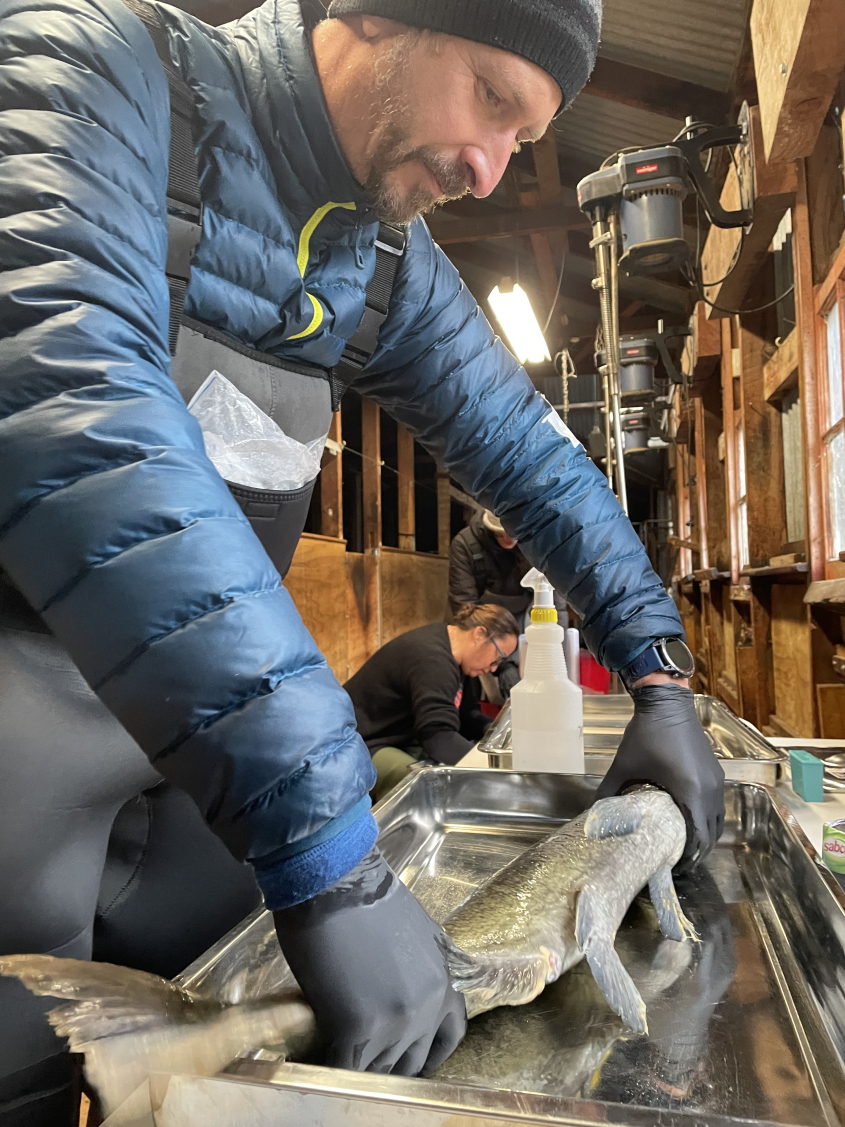
My area of specialty is in fish disease ecology and research in fish pathology. My research utilizes pathology studies and molecular approaches to understand the pathogenesis and epidemiology of fish disease. My research focuses on understanding how environmental changes in aquatic ecosystems influence fish diseases. To accomplish this, my lab conducts field studies to identify disease issues in fisheries populations and combines this with experimental laboratory research to better understand how environmental factors influence virulence and disease outcomes. My ultimate goal is to apply this to manage and mitigate the impacts of disease towards the conservation of fisheries populations.
Q: What drew you into this area?
Early in my education, having been fascinated with fisheries and aquaculture, I undertook an undergraduate degree with a major in aquaculture. After taking a fish disease course, I saw a research career where I could combine fisheries biology and microbiology/pathology. I undertook a Ph.D. in fish health and comparative fish pathology at the Atlantic Veterinary College in Prince Edward Island in Canada, which had a comprehensive program in fish health. Though I was drawn into this career by a love for the outdoors and fishing, I do much less fishing these days. My current motivation in my research is improving fish health to support fisheries conservation in the face of stressors, such as habitat loss, urbanization and climate change.
I also believe that a major component of protecting fisheries is establishing sustainable aquaculture practices to reduce fishing pressure on wild fish populations. Growing aquaculture within the United States is critical to reduce our dependence on wild fish to feed a growing human population. Though aquatic animal health has been a limiting factor for sustainable aquaculture, management practices and increased veterinary involvement in aquatic health is critical for a successful aquaculture industry.
Q: What about your professional work are you most proud of?
I am proud every time we see a study through to a final peer-reviewed publication, as this is the point where our science becomes public within the scientific community. I’ve also loved to see staff in my lab go beyond scientific literature and professional conferences to communicate our research. As scientists, we are trained to communicate within the scientific community, though we are not always effective at bringing our science in front of the public. While I was in the USGS, our lab staff had voluntarily attended a public science fair and interacted with hundreds of people to communicate the importance of our science. I think this type of communication is often overlooked but critical for our field. Anything that helps bring our science and conservation mission into the public eye will help gain support for this area.
Q: What impacts or applications do you hope to see your work have?
Applied science is not done in a vacuum and extends beyond our individual work in the lab. The more we can integrate our laboratory research within state, tribal, and federal priorities, the more likely we can effect change. For example, our current research with endangered Lost River and Shortnose Suckers in the Upper Klamath Basin in Oregon, has depended on strong communication with a variety of research partners including the Federal Bureau of Reclamation, U.S. Geological Survey, U.S. Fish and Wildlife Service, Klamath Tribes, and state partners. These interactions and adapting knowledge from research partners are what will help integrate your research towards the successful conservation of species. I hope that my future research will continue depending on these valuable interactions.
Seeing how fisheries declines have impacted indigenous communities, which historically depended on these fisheries from a subsistence and cultural perspective, has added additional meaning to my research. Several recent projects that I’ve been involved with have allowed me to learn from indigenous perspectives. I hope to see my work continue supporting fisheries for indigenous populations that have lost these resources as a result from urbanization and habitat loss.
Q: What’s something most people don’t know about you?
I love trying different foods while traveling, as foods are tied to people’s culture and history. It is interesting to learn about how certain cultures have influenced the food that they eat. Working a lot with aquatic parasites, sometimes people are surprised by my love for raw seafood. Aside from eating good food, I also love hiking, snowboarding, and playing hockey.
Q: What’s the best part of your job?
The best part of my job are the interactions and collaborations that are developed while working on larger projects that involve multiple agencies. I’ve found the field of aquatic animal health to be extremely welcoming and collaborative, which has helped to develop supportive networks. I also really value meeting and interacting with future aquatic veterinarians and professionals in the AQUAVET program.
Q: What’s the most challenging part?
As scientists we are trained well on conducting sound and meaningful science, though this does not always translate into developing management skills needed to build and manage a lab. Much of this is gained through experience. Despite these challenges, this is also one of the most rewarding aspects. As scientists, we are required to constantly refine these skills and continue learning from experiences.
And of course, a shared challenge for many scientists is acquiring a steady stream of funding. With shifting funding priorities, it is important to keep your research malleable to match funding opportunities. This can sometimes mean that we are required to put our passion-projects to the side and embrace new opportunities.
Q: What are the benefits of working at CVM? At Cornell?
There is a strong commitment to wildlife and ecosystem health, which has created a strong and diverse group of scientists committed to conservation and improving environmental health. Having scientists with such diverse expertise on campus makes it easy to collaborate and develop strong teams that span multiple disciplines. This is a huge advantage, as applied science benefits from this kind of diverse expertise. I am excited to form these collaborations and apply them towards the conservation of aquatic animals!