

Stroke test tech receives 'breakthrough' status from FDA
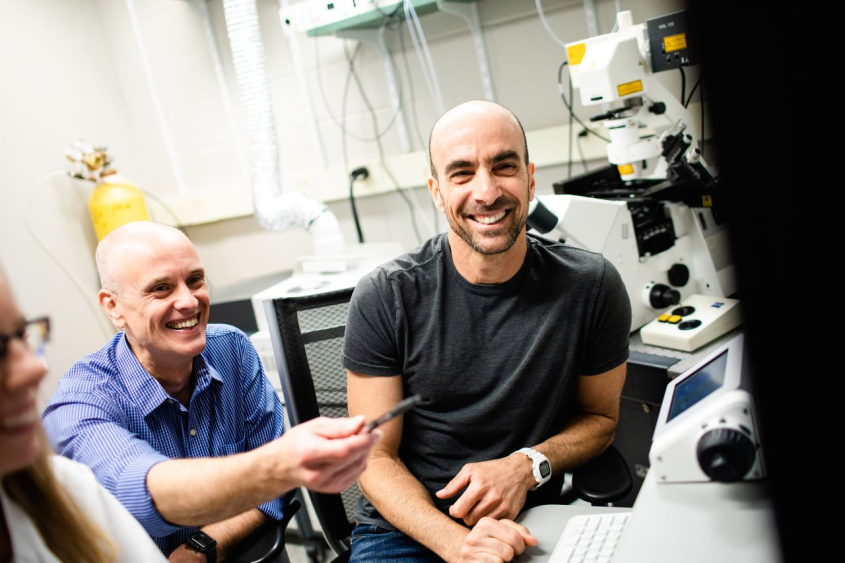
Drs. Alex Travis and Roy Cohen. Photo: Allison Usavage/Cornell University
When someone experiences a stroke, every minute counts. The sooner doctors can determine what kind of stroke a patient is having, the sooner they can begin treatment that may save brain function and improve recovery. Yet diagnosing the most common type of stroke, acute ischemic stroke, isn't always straightforward. In fact, studies have shown that nearly one in six strokes is initially missed, which significantly increases the risk of cognitive impairment, disability and death.
That's the challenge Baker Institute for Animal Health researchers Dr. Alexander Travis, professor of reproductive biology, and Dr. Roy Cohen, research assistant professor, set out to help solve.
While conducting research at the Baker Institute, Travis and Cohen developed an innovative technology that could rapidly detect a biomarker associated with acute ischemic stroke using a simple blood test. Recognizing its potential to improve patient care, together with David Fischell ’75, M.S.E. ’78, Ph.D. ’80, a Cornell Trustee Emeritus, they co-founded TETmedical to advance the discovery beyond the research laboratory and into clinical development.
That journey recently reached an important milestone. TETmedical announced that the U.S. Food and Drug Administration (FDA) has granted Breakthrough Device Designation to NSE-FAST®, the first rapid blood test designed to aid in the diagnosis of acute ischemic stroke. The designation recognizes technologies with the potential to significantly improve care for life-threatening conditions and provides an important accelerated pathway for collaboration with the FDA as development continues.
TETmedical is now leading the clinical development of the NSE-FAST®, with a large multi-center clinical study planned to start later this year. While additional testing and FDA review remain ahead, the designation marks an important step toward bringing this innovation to physicians and patients.
For the Baker Institute, this milestone represents more than scientific progress. It demonstrates how discoveries made by institute researchers can extend far beyond the laboratory through entrepreneurship and industry partnerships. By transforming promising research into technologies that address critical medical needs, Baker scientists are helping shape a future where discoveries improve the lives of both animals and people.
Written by Teresa Griffin