
The dream that drives Alexandria Henderson, class of 2028
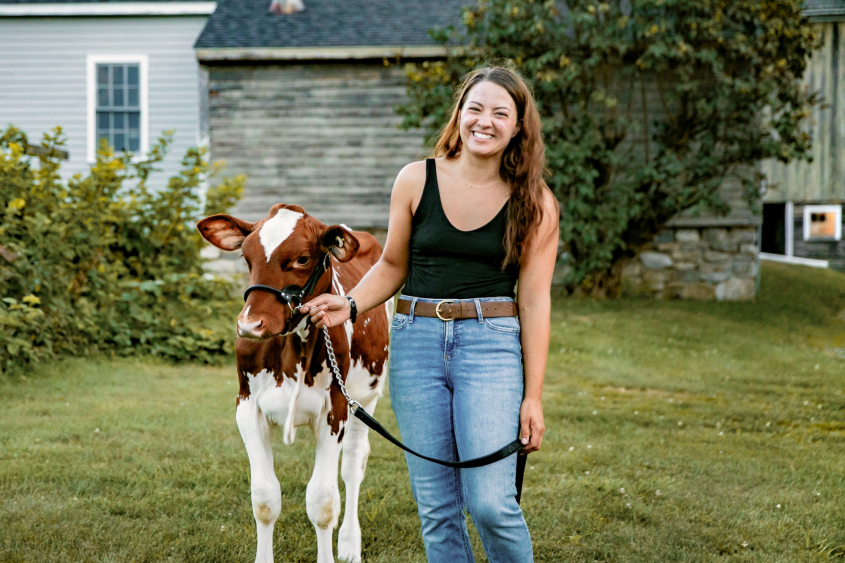
Alexandria Henderson, class of 2028, has worked with hundreds of cows. It is the tragic loss of three of them that put her on the path to becoming a veterinarian.
Her love of cows grew at her local 4-H program, which showcased cows at local fairs and agricultural exhibits. In college, she studied animal science, taking classes in herd management, advanced genetics, and advanced reproduction. Her dream was to one day own a farm.
Inspired by her 4-H leader, she interned at various dairy farms throughout undergrad. “My 4-H leader had a big influence on me. He owns his own dairy. We became like family,” said Henderson.
Post graduation, she did an internship on a farm that was milking 1,500 cows, applying her newly acquired skills in genetics and reproduction. Later, she started to work as a herdsman. “I was happy with my work, I was doing well with my own cows. These cows, they were like my kids,” she said.
Then, in November 2021, a series of bad accidents changed her life, including a tragic barn fire. According to FEMA, roughly 20,000 agricultural fires happen each year, resulting in $102 million in property loss, and with 22% of them affecting cow and cattle properties. Sadly, Henderson was part of this statistic: three of her cows died. One of them, the first cow she ever owned, was a week from giving birth. The tragedy shattered Henderson's dream. She was so distraught, she considered never owning cattle again."
And then her community rallied around her. They organized a benefit, with the profits going toward rebuilding her farm. Slowly, she came back. When she returned to work, Henderson became close with the vets servicing the farm. This friendship sparked an interest in veterinary medicine and inspired Henderson to apply to vet school, despite her fear that her lack of any small animal experience would hurt her chances. “I thought I was not a well-rounded candidate so I didn't think I would be accepted,” she said.
Nonetheless, in addition to her full-time job, she took physics at a local community college to meet the requirements. Not only was Henderson accepted to Cornell's College of Veterinary Medicine, her first choice, but she just received a RED scholar award. “It really feels like a dream to get it!” said Henderson.
Each year, the D.V.M. program at Cornell supports three exceptional students through the RED (Reducing Educational Debt) program. RED scholars, like Henderson, receive two years tuition-free.
With $4M in scholarships awarded annually, and 65 to 70 percent of students receiving scholarship aid, the true cost of a veterinary degree from Cornell is more affordable than many expect.