

Late cancer scientist’s legacy lives on with new experimental resources for canine lymphoma research

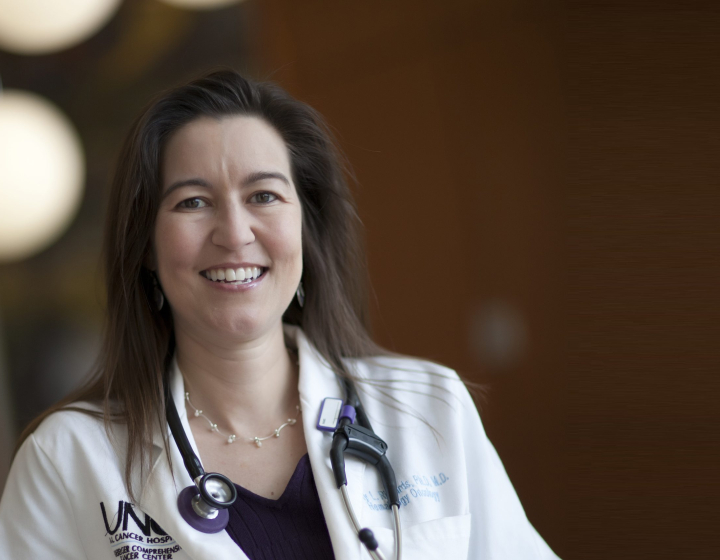
The late Dr. Kristy Richards '90, a groundbreaking cancer researcher and associate professor of biomedical sciences.
Written by Lauren Cahoon Roberts
Dr. Kristy Richards ’90 came to the Cornell University College of Veterinary Medicine (CVM) with a vision — study canine cancer patients to improve treatments for both dogs and humans.
As a human oncologist, Richards came to CVM with the aim of recruiting canine lymphoma patients for novel therapeutics, including immunotherapy, and using those results to better inform both veterinary and human medicine. The approach was trailblazing, just like its champion — Richards arrived at Cornell with fanfare, establishing ties with Weill Cornell Medicine and a novel facility designed to create cutting-edge cancer research tools. Tragically, in 2019, Richards passed away, putting a devastating halt to her comparative cancer research.
“Kristy was such an effective driver of this project — when she passed it was really hard,” says Dr. Robert Weiss, a colleague of Richards. “But we were all committed to seeing it through, to see her tools benefit the scientific community.”
That commitment has come to fruition with a new collaborative study published Sept. 17 in the journal Cells. It details the successful creation of three new patient-derived xenograft (PDX) models and two stable cell lines from naturally occurring canine B-cell lymphoma tumors, using samples collected from pet dogs diagnosed with the disease.
“This is a true continuation of what Kristy was trying to do,” says Weiss, who is one of the authors on the paper, along with many colleagues at CVM and Weill Cornell Medicine. “Creating new resources for more effectively treating diseases in both pets and people. This work does exactly that.”
New ways to test cancer drugs
While B-cell lymphoma is one of the most common cancers in dogs, there have been limited reliable laboratory models to test new therapeutics against it. “There’s a strong clinical need for these tools in veterinary medicine, because the current therapies don’t cure canine lymphoma patients,” Weiss says.
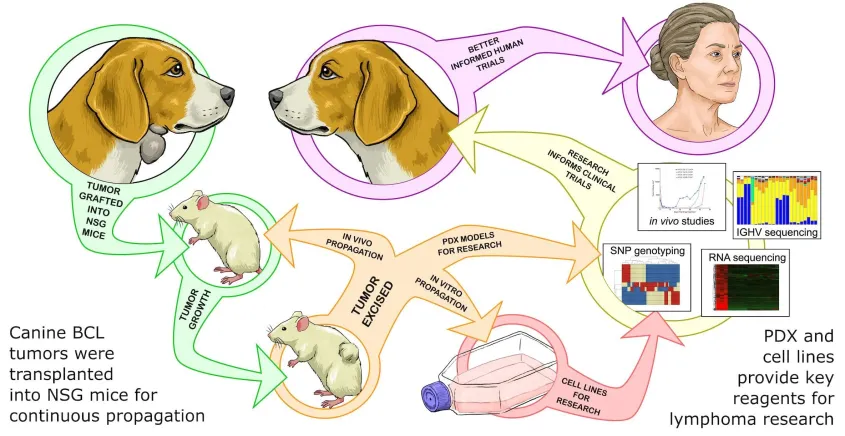
To create these tools, Weiss and his colleagues transplanted tumor tissue from canine lymphoma patients into immunodeficient mice, creating the xenograft models that closely mirrored the genetic and biological features of the dogs' original tumors. The researchers also successfully adapted the xenograft tissue into laboratory-grown cell lines. The xenografts and the cell lines represent two gold-standard tools for drug testing: in vitro (petri dish) and in vivo (animal) models. Canine lymphoma patient tumors were used to create experimental mouse and cell models; these can be used to find new therapies for both humans and dogs. Illustration: Dr. Robert Weiss et al.
Collaboration is a catalyst
These new tools were created with the same ethos that Richards brought to Cornell — collaboration. “There was a lot of different expertise needed to make this project happen,” says Weiss, noting the studies different contributors: colleagues at the human and veterinary hospitals and biobank to aid with access to patients and tumor samples; pathologists to characterize the diseases in tissue; experts in cell cultures and mouse models; bioinformatic and computational analysts to parse out genetic features. “It brought so many people together, and that was what Kristy was really skilled at,” Weiss says.
With these new experimental tools, scientists can identify new drug targets and evaluate experimental therapies before they move into clinical trials. And thanks to the close parallels between canine B-cell lymphoma and human non-Hodgkin lymphoma, the work could ultimately have implications beyond veterinary medicine.
“Kristy’s goal was always to try to find a way to more effectively treat diseases both in people and pets,” says Weiss. “It’s gratifying to see that legacy of hers continue.”