

Cornell Ties to Tuskegee: A rich legacy of academic partnership
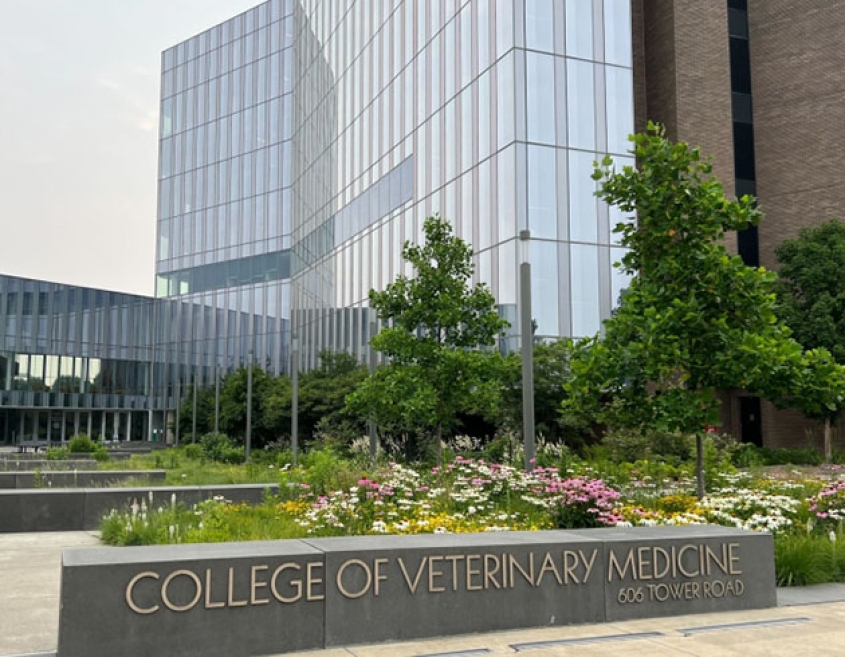
As part of the national Student American Veterinary Medical Association (SAVMA) “sister program” initiative, Cornell University and Tuskegee University will be working together to foster closer connections between the two colleges. The effort has been spearheaded by 2025 SAVMA presidents Jeremiah Pouncy at Cornell and Haleigh Johnson at Tuskegee. Their work resulted in plans for student exchanges beginning this semester with several Tuskegee students joining Cornell’s 10th Annual Animal Health Hackathon this month and Cornell students attending Tuskegee’s 60th Annual Veterinary Medical Symposium in March. The exchanges are being supported by generous alumni donors.
These new connections build on a legacy of partnerships between these two institutions. “The historical relationship between Tuskegee and Cornell’s veterinary colleges is an important part of our college’s legacy,” says Austin O. Hooey Dean of Veterinary Medicine Lorin D. Warnick, D.V.M., Ph.D. ’94. “The scholarly ties between many of our academic leaders strengthened both of our institutions.”
Tuskegee’s veterinary program was founded by Frederick Douglas Patterson, “a man so remarkable that I consider him to be one of the three most influential U.S. veterinarians of all time,” wrote former CVM dean Dr. Donald Smith. Patterson came to Cornell after receiving a fellowship from the Rockefeller Foundation to study bacteriology under Dr. William Hagan, earning his Ph.D. in 1932.
Prior to Patterson establishing the Tuskegee University College of Veterinary Medicine (TUCVM), veterinary colleges in the South excluded Black students. At that time, there were only a few dozen Black veterinarians, trained primarily at Ohio State University, Kansas State University, the University of Pennsylvania and Cornell.
Upon completing his graduate degree at Cornell, Patterson would go on to Tuskegee. There, he was the first faculty member with a doctorate, eventually rising to become the institution’s third president at age 33 in 1935. As president, Patterson founded the TUCVM in 1945 (as well as the College of Engineering, the dietetics program, the United Negro College Fund and the aviation program that yielded the Tuskegee Airmen, the famous World War II fighter squadron). Patterson’s accomplishments in higher education and philanthropy were so wide-reaching and impactful that he received the Presidential Medal of Freedom from President Ronald Regan in 1987.
At Cornell, Patterson’s former mentor Hagan became dean of the veterinary college in 1932. He had a close relationship with TUCVM dean Dr. T. S. Williams, as they had both received their veterinary degrees from Kansas State University. When Hagan became chair of the American Veterinary Medical Association’s first institutional review team, he recommended the full accreditation of TUCVM in 1954.
The collegiality between Cornell and Tuskegee saw a rich exchange of academic talent. Charles Robinson, D.V.M. ’44, the only Black veterinary student to attend Cornell during the 1940s, served as an early faculty member of the new veterinary school established by Patterson. Tuskegee faculty member Dr. Eugene W. Adams (another Kansas State veterinary graduate) came to Cornell for graduate work in the 1950s and eventually earned his Ph.D. in pathology in 1961. Two of his colleagues followed suit: Dr. W. C. Bowie, who obtained his Ph.D. in physiology in 1960, and Dr. R. C. Williams, who earned his Ph.D. in anatomy in 1961. Adams, Bowie and Williams all became leaders at Tuskegee, with Bowie serving as dean for 18 years.
“The need for some of Tuskegee’s veterinary faculty to get advanced degrees in the basic science disciplines represented a critical step in the development of their educational and academic program,” Smith wrote in Perspectives in Veterinary Medicine. “During the 1960s, this need was met through an informal agreement with Cornell University, built upon the professional relationship and personal friendship of the deans at the time, W.A. Hagen (Cornell) and T.S. Williams (Tuskegee).”
The impacts of these partnerships stand as an example to be emulated. “The partnership between Tuskegee and Cornell is a testament to the power of cross-institutional collaboration,” says Warnick.
“I look forward to the continued creation of new activities and connections through the SAVMA sister college collaborations,” said Dr. Ebony Gilbreath, dean of TUCVM. “We look forward to supporting our student leaders as they develop activities to strengthen ties between our colleges in the coming years.”
Written by Lauren Cahoon Roberts