

Anesthesiology and Pain Medicine Residency
The Cornell University Hospital for Animals (CUHA) offers two 3-year residency positions annually through the Veterinary Internship and Residency Matching Program (VIRMP).
Why Cornell
Our program provides residents with world-class advanced training in veterinary anesthesiology and pain medicine, extensive clinical and laboratory teaching experience, and robust research mentorship to prepare you for the American College of Veterinary Anesthesia and Analgesia (ACVAA) Certifying Examination and a standout career. Our former residents practice and contribute to our specialty globally in academia, private practice, industry, and other settings.
Teamwork
Our dedicated team consists of 6 board-certified faculty members, 1 board-eligible faculty member, 6 residents, 15 licensed veterinary technicians, including several who are credentialed as a Veterinary Technician Specialist (VTS, Anesthesia and Analgesia), and 1 veterinary assistant. Together, we pride ourselves on a culture of teamwork, collegial inter-service collaboration, and support of physical and mental health.
Program Highlights
Diverse and Heavy Caseload
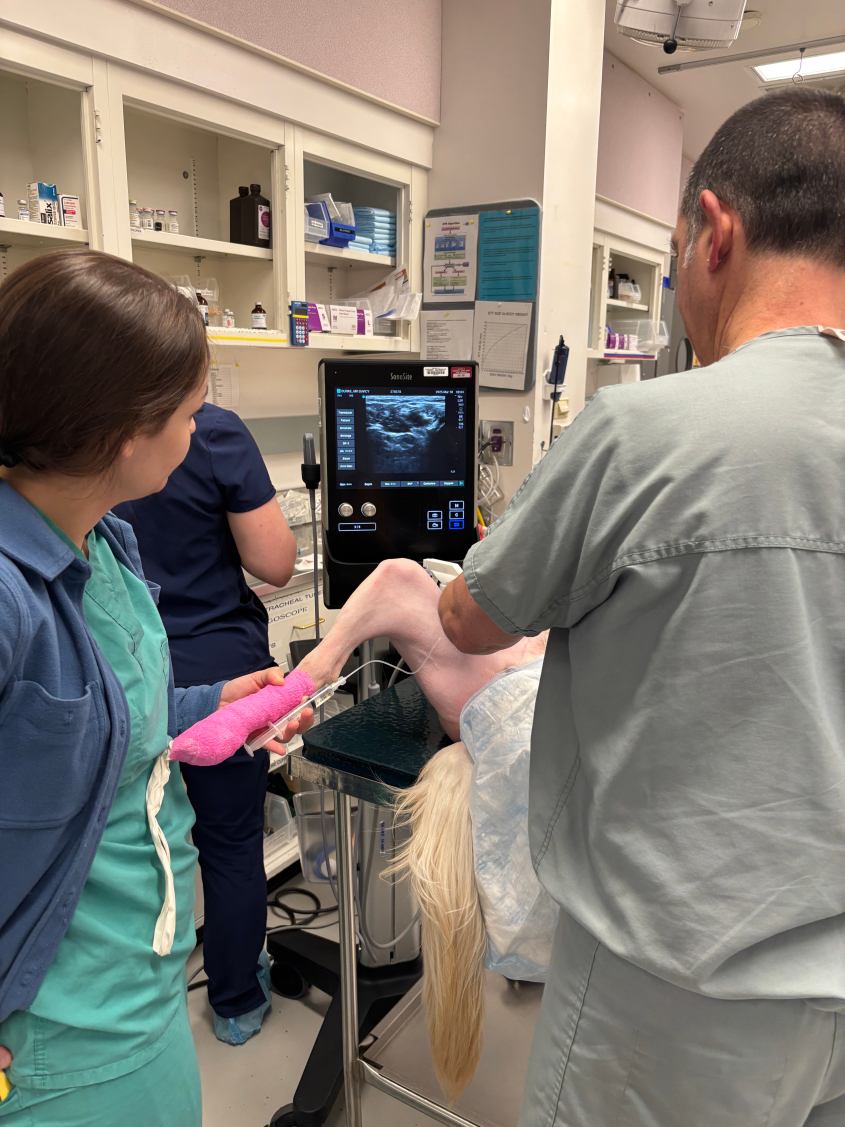
Residents enjoy primary case responsibility under direct faculty supervision, managing 1–2 cases per day. With an annual service caseload of approximately 4,000 small animal and 1,000 large animal (equine, ruminant, porcine, and camelid), patients, plus exotic pets, native wildlife, and zoological species, our residents routinely fulfill their ACVAA case log requirements well before the halfway mark of the program. Residents quickly become proficient in patient safety procedures and technical skills such as arterial catheterization, central venous catheterization, urinary catheterization, nasogastric tube insertion, and more.
Cutting-edge Equipment
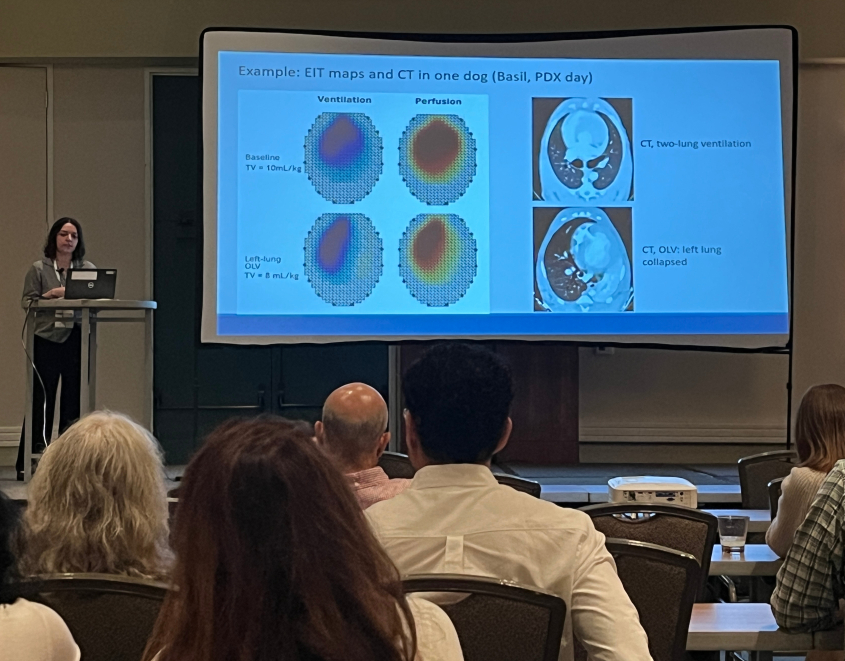
Between the CUHA and the section’s anesthesiology laboratory, residents gain experience with refurbished human small animal anesthesia machines, Tafonius large animal ventilators, biventricular and pulmonary artery catheterization, multiple cardiac output monitoring techniques, electrical impedance tomography (EIT), one-lung ventilation, and more.
World-class Regional Anesthesia and Interventional Pain Medicine Training
Solid didactic training provides the foundation for performing regional and interventional techniques safely and competently in client-owned animals. Residents develop strong skills in ultrasonography throughout the program. First-year residents are introduced to epidural anesthesia/ catheterization and ophthalmic/ maxillofacial blocks in the laboratory setting, then begin performing these procedures in CUHA patients. After completing an online course in advanced regional anesthesia and participating in the world-renowned Regional Anesthesia Boot Camp, they begin performing ultrasound-guided advanced peripheral nerve blocks in CUHA patients under faculty supervision. Residents are also exposed to interventional pain medicine techniques such as continuous and pulsed radiofrequency and cryoneurolysis.
Unique Global Veterinary Experience and Human Anesthesiology Experience
Residents benefit from exceptional off-site experiences, including a unique resident exchange program with the Anesthesiology Department at Weill Cornell Medical Center in Manhattan, as well as funded trips to the Belize Zoo in Central America to anesthetize native wildlife and to South Africa for a wildlife capture course, among others.
Research Mentorship and Funding
Complete a basic or clinical research project under faculty supervision. Faculty have interests in diverse areas including cardiopulmonary physiology and resuscitation, regional anesthesia and pain management, and neuromuscular relaxants. Calls for Resident Research Grant Applications (written with faculty assistance) occur biannually, and successful competition provides up to $10,000 in funds to support a research project. All residents must publish a first-author peer-reviewed manuscript for the ACVAA to confer Diplomate status. Resident funds are available to support travel to present an abstract at a national or international conference.
Rigorous Didactic Instruction
Prepare for the ACVAA Certifying Examination with our highly structured weekly Advanced Veterinary Anesthesiology course (VETCS 7100)—a 3-year rotating master curriculum featuring lectures by both faculty and residents, end-of-semester mock multiple-choice examinations, and highly specialized wet labs (e.g., epidural anesthesia, cardiac output monitoring, endoscopic intubation, one-lung ventilation). Laboratories in laboratory animal anesthesia are held in collaboration with the Center for Animal Resources and Education (CARE). All residents complete RECOVER training. Recordings of lectures and all lecture and laboratory materials are available to residents.
Program Structure and Schedule
The residency balances clinical anesthesiology duties with ample personal development time, splitting resident focus across clinical service and development (off-clinics) time for research, studying, required CUHA specialty rotations (Cardiology, Diagnostic Imaging, Emergency and Critical Care, Dentistry and Oral Surgery, Sports Medicine and Rehabilitation) and external rotations.
Residents rotate through six shifts
- small animal anesthesia 1 (SA1, scheduled cases)
- small animal anesthesia 2 (SA2, urgent/emergent cases)
- large animal anesthesia (LA)
- swing
- nights
- development
Shift details
The SA and LA residents generally arrive at 7:30-8 AM and leave when their cases are complete, with the goal of relief by the swing or nights resident between ~5-7 PM.
The swing resident arrives at 2 PM and provides assistance where needed until 10 PM; this resident serves as a back-up on-call resident from 10 PM-8 AM if two cases must be anesthetized simultaneously after-hours.
The nights resident arrives at 5 PM, finishes ongoing daytime cases, and anesthetizes after-hours cases until 8 AM. Each nights rotation is followed by a development rotation to allow rest and recovery.
The resident on development often takes call from 8 AM Saturday to 8 AM Sunday in place of the nights resident.
Additional shift information
No resident is permitted to work longer than 24 hours.
A licensed veterinary technician is on-call to assist the resident from 8AM-8PM on Saturday and Sunday.
Evaluation and Mentorship
Your growth is fully supported from day one. Residents benefit from a 90-day evaluation, monthly group meetings with the residency director, and biannual formal reviews. A gradual and confident transition into after-hours on-call duty is assured by pairing first-year residents with second- and third-year residents during 12- or 24-hour after-hours training shifts for the first six months.
After the first three months, first-year residents begin anesthetizing some cases alone if appropriate during these shifts, with a second- or third-year resident available for assistance if needed. During the holiday season, first-year residents begin on-call without a resident mentor. Faculty support after-hours is always available.
Further information can be found at https://www.virmp.org.