


A legacy of learning: Phi Zeta’s century of veterinary scholarship
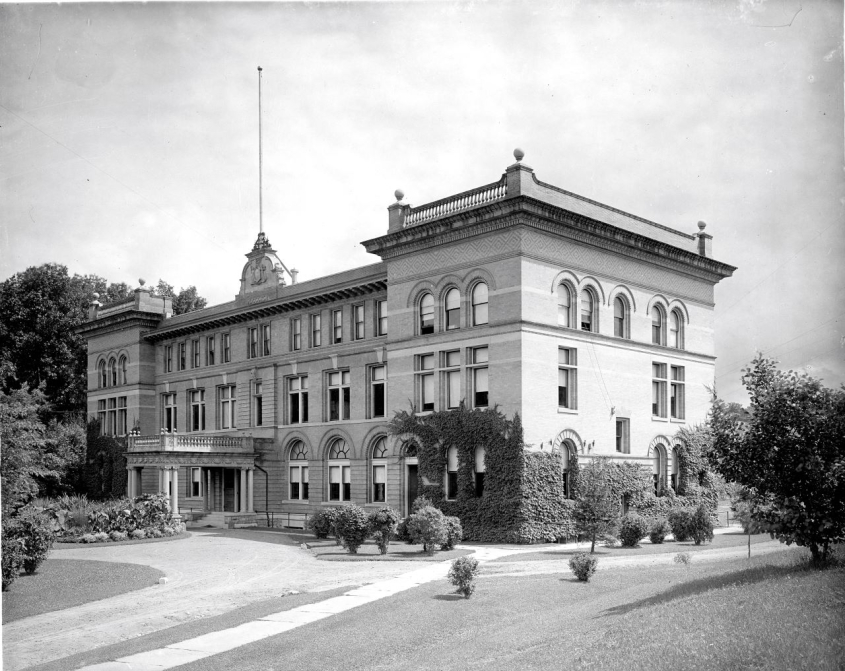
James Law Hall circa 1920. Photo: CVM archives
One hundred years ago, a small group of veterinary students and faculty under their dean, Dr. Veranus Alva Moore, 1887, at Cornell University gathered to launch an endeavor that would elevate their profession — an honor society dedicated to scholarship, integrity and the welfare of animals. Based on the Greek word philozoi (“love of animals”) they named it Phi Zeta.
In 2025, Cornell and veterinary colleges nationwide mark Phi Zeta’s 100th anniversary, honoring a shared mission that has linked generations of veterinarians.
“Phi Zeta reflects the academic excellence and professional integrity that have long defined Cornell’s College of Veterinary Medicine (CVM),” said Lorin Warnick, D.V.M., Ph.D. ’94, the Austin O. Hooey Dean of Veterinary Medicine and a 1987 inductee to Colorado State University’s Theta chapter. “It’s remarkable that an idea born here a century ago continues to inspire students and faculty across every veterinary college in the country.”
A profession in turmoil
That vision first emerged in the aftermath of World War I, when the veterinary profession faced one of the most turbulent periods in its history.
“The war had taken a horrible toll on veterinary colleges,” said Susanne Whitaker, a retired veterinary medical librarian at CVM who has conducted research into the history of Phi Zeta. As both students and faculty were pulled into active wartime service efforts, enrollment in U.S. veterinary colleges began to decrease. Within a decade, it had plummeted by nearly 80 percent to only 523 students.
Private veterinary schools were especially hard hit. Not only were they grappling with a decrease in tuition income, but by 1921 most of them had also been removed from the list of approved colleges. The institutions were unable to meet recently elevated American Veterinary Medical Association (AVMA) and U.S. Civil Service Commission standards, which had, for example, increased the course of study from three to four years and required admitting only students who had completed four years of high school.
Then, in 1926, only about 130 veterinarians graduated from the remaining thirteen recognized veterinary colleges in the United States and Canada — the smallest number on record.
At the same time, the profession itself was changing. With the expanded use of motor vehicles, “there was also a transition from veterinarians essentially being horse doctors to practicing modern veterinary medicine,” Whitaker explained. Their focus broadened to livestock and the increasing number of companion animals, giving rise to the first small animal practices.
Dean Moore watched these upheavals with growing concern. At the 9th Annual Meeting of the Southeastern States Veterinary Medical Association in November 1924, he declared that “there has been no time in the history of veterinary medicine in America when there was a like, or even an approximate succession of events, which seem so to threaten veterinary medicine as those which have been recorded in the last few years.”
Any solution, he maintained, had to include high educational standards, ethical conduct, and honest service — as well as the willingness of those in the profession to adjust. “The veterinarian can and must create for himself a different place than he has occupied in the public eye heretofore,” he said.

Seeds of an idea
Given these major transitions in veterinary medicine, “I can only speculate that Dean Moore as well as other faculty and senior veterinary students may have felt it was time to emulate other fields by creating an honorary society,” Whitaker said.
It is likely that Moore had a model close by in Dr. William Webster Root 1890, M.S. 1894. After earning degrees in chemistry, the Cornellian had moved out to the Midwest to enroll at the College of Physicians and Surgeons of Chicago. Concerned about many fellow students’ crude, unscholarly, and unethical behavior, the medical student and five friends founded the Alpha Omega Alpha Honor Medical Society in 1902, modeled on Phi Beta Kappa. They hoped to encourage their colleagues to “be worthy to serve the suffering,” according to the society’s motto. Once certified as a physician, Root returned to Slaterville, just outside of Ithaca, where he was also instrumental in creating the Association of College Honor Societies (ACHS) in 1925, and administratively ran both AΩA and ACHS from his home.
“The direct connection, support, or encouragement of Dr. Root for Dean Moore to propose establishing Phi Zeta remains unknown,” said Whitaker. “But such a connection or influence seems more than coincidental, given the local professional, social, and physical geography.”
A society is born
The idea soon took tangible form.
The honor society was officially founded on May 4, 1925, according to a Cornell Daily Sun article that appeared the next day. That afternoon, a group of faculty and upper-class students gathered in James Law Hall to vote on the constitution and by-laws of the new Alpha Chapter.
With Moore at its helm as elected president and several other faculty officers, the society began its mission “to recognize and promote scholarship and research in matters pertaining to the welfare and disease of animals.” Its name, Phi Zeta, was chosen on the advice of William Prentice Bristol, Cornell emeritus professor of Greek classics, while its emblem — a blue and gold pendant formed by the letter Phi superimposed on the letter Zeta — was designed by renowned artist and ornithologist Louis Agassiz Fuertes, 1897.
Moore and his colleagues hoped that the ideals represented by those letters would take root and grow into a lasting symbol of the profession’s highest aspirations.
Phi Zeta grows up
Indeed, a century later, Phi Zeta’s mission continues to resonate among veterinary students, faculty, and professionals far and wide.
Since the chartering of the Beta Chapter at the University of Pennsylvania in 1928 — where a similar idea had been taking shape independently — Phi Zeta has continued to expand its reach. The society became a national organization the following year at the 30th annual convention of the American Veterinary Medical Association (AVMA) and today includes chapters at all 33 accredited veterinary schools in the United States.
Every year, local societies continue the founders’ tradition of honoring students and professionals who exemplify Phi Zeta’s ideals of academic achievement and good moral character. Third-year students in the top 10 percent of their class and fourth-year students in the top 25 percent are eligible for invitation. Faculty, residents, and practicing veterinarians who have made significant contributions to veterinary medicine may also be elected, along with honorary members from outside the field who have advanced the science or welfare of animals.
“I think it’s important to recognize students who go above and beyond and are really serious about their studies and scholarship,” said Dr. Kathy Earnest-Koons, senior lecturer emerita at CVM. “I’ve really enjoyed getting to know these students.”
Fondly known to many as “Dr. E-K,” Earnest-Koons was herself inducted into the University of Georgia’s Xi chapter during her veterinary studies and transferred her membership to the Alpha Chapter when she came to Cornell in 1990. She went on to play a central role in guiding the society for more than two decades — serving as Cornell’s chapter president from 1994 to 2001, as national Phi Zeta president for two years, and again as Alpha Chapter president until her retirement in 2017.
“It’s certainly a selective organization and can feel a little esoteric,” added Dr. Cheryl Blaze, associate professor emerita of clinical sciences at Tufts University, where she was president of the Alpha Beta chapter before serving the national organization as secretary and president for about a decade. “But it also gives people a sense of belonging and community. Members want to do well and contribute to the profession.”
Celebrating scholarship, building community

Members have opportunities to do just that through Phi Zeta’s ongoing activities. Each spring, chapters across the country host annual banquets and initiation ceremonies to welcome new members, recognize outstanding scholarship, hear invited speakers, and present the Phi Zeta Award to the highest-ranking second-year student.
Part of the ritual includes students putting their names in “the book,” originally signed by the founding members. “It’s an excellent reminder of the traditions we have at the college,” said Jessica McArt, D.V.M. 07, Ph.D. ’13, professor in the department of population medicine and diagnostic sciences, who became a Phi Zeta member herself in 2007.
For Soon Hon Cheong, Ph.D. ’12, associate professor in the department of clinical sciences and until recently the Alpha Chapter’s president, the ceremony is a highlight of the academic year. “It’s quite special because you get to see some of the talented students and faculty members,” he said.
Written by Olivia Hall