



Culture Specimen Handling
View a printable version of this page
Tips
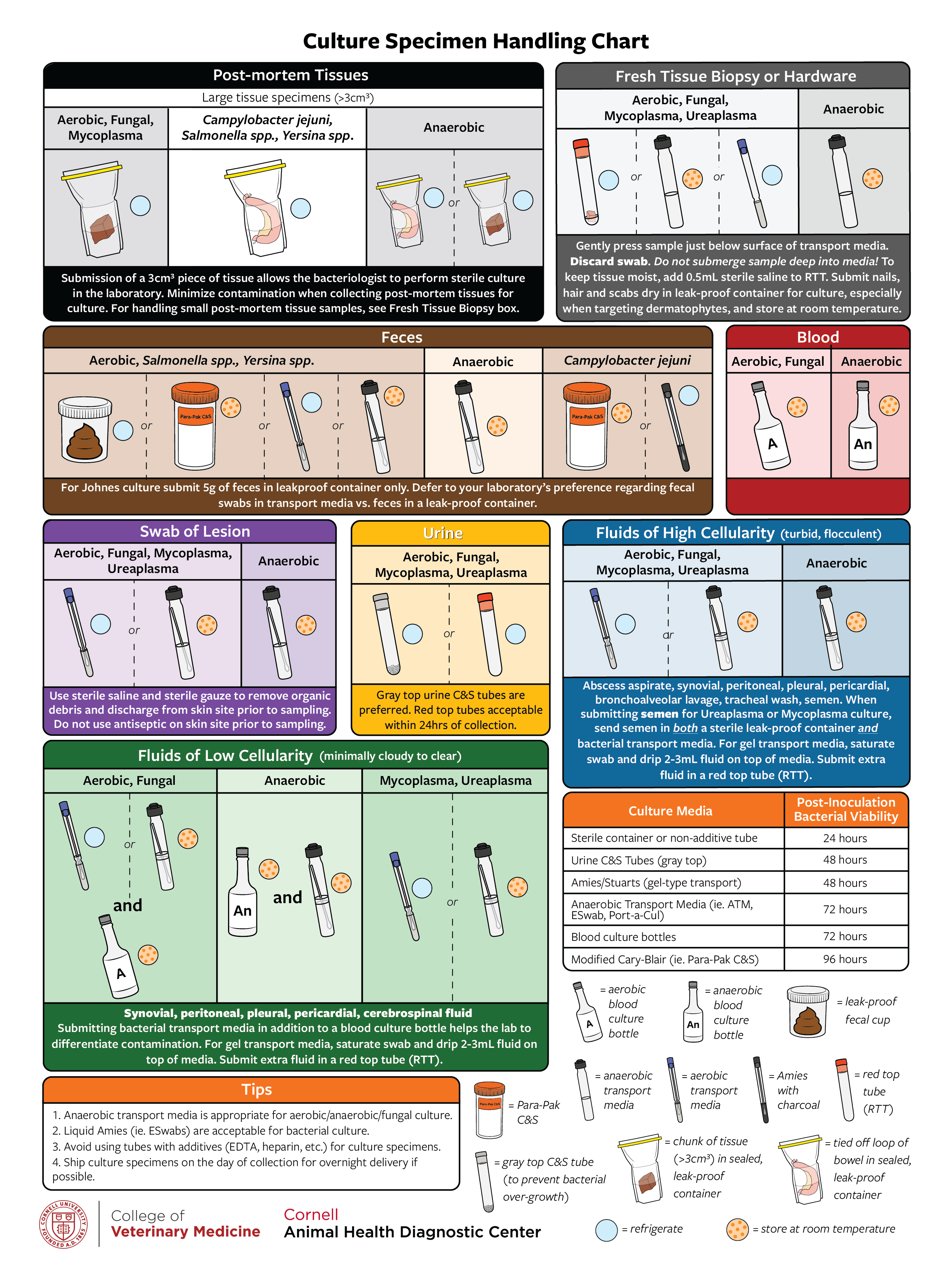
- Anaerobic transport media is appropriate for aerobic, anaerobic, and fungal cultures.
- Liquid Amies (e.g., ESwabs) are acceptable for bacterial culture.
- Avoid using tubes with additives such as EDTA or heparin for culture specimens.
- Ship culture specimens on the day of collection for overnight delivery whenever possible.
| Culture Media | Post-Inoculation Bacterial Viability |
|---|---|
| Sterile container or non-additive tube | 24 hours |
| Urine C&S Tubes (gray top) | 48 hours |
| Amies/Stuarts (gel-type transport) | 48 hours |
| Anaerobic Transport Media (i.e. ATM, ESwab, Port-a-Cul) | 72 hours |
| Blood culture bottles | 72 hours |
| Modified Cary-Blair (i.e. Para-Pak C&S) | 96 hours |
Image key
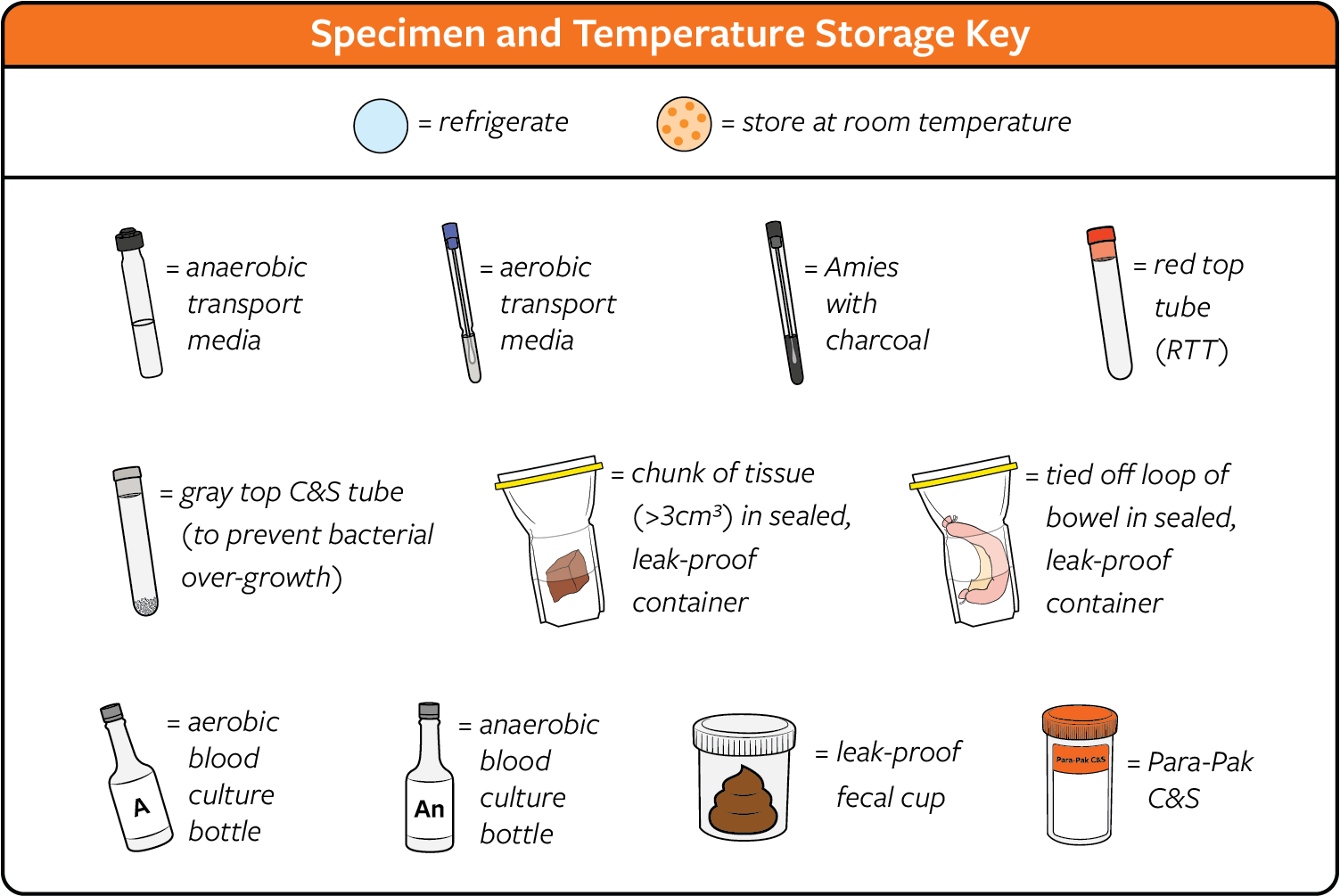
The Specimen and Temperature Storage Key, with two sections.
The first section contains the symbols for temperature. A light blue circle indicates a specimen should be refrigerated. A light orange circle with red dogs indicates a specimen should be kept at room temperature.
The second section contains the symbols for storage materials. A narrow vial with a black screw top with clear liquid inside: Anaerobic transport media. A narrow vial with a blue top and a divot near its base, containing a swab whose head is in light gray gel: Aerobic transport media. A narrow vial with a black top, containing a swab whose head is in dark gel: Amies with charcoal. A narrow vial with a red top: Red top tube (RTT). A narrow vial with a gray top, containing small dots at the bottom of the vial: Gray top C&S tube to prevent bacterial overgrowth. A plastic bag with a triangular top and square base that has a yellow strip at its mouth, containing a cube of brown tissue in clear liquid: Chunk of tissue that's greater than 3 centimeters to the third power in sealed, leak-proof container. A plastic bag with a triangular top and square base that has a yellow strip at its mouth, containing a piece of bowel in clear liquid: Tied-off loop of bowel in sealed, leak-proof container. A small bottle with a gray screw-on top and a label with the letter "A" around it: Aerobic blood culture bottle. A pill bottle with an orange screw-on top and a label with "Para-Pak C&S" around it: Para-Pak C&S. A medical cup with a white screw-on top, containing an illustration of feces: Leak-proof fecal cup. A small bottle with a gray screw-on top and a label with the letters "An" around it: Anaerobic blood culture bottle.
By specimen type
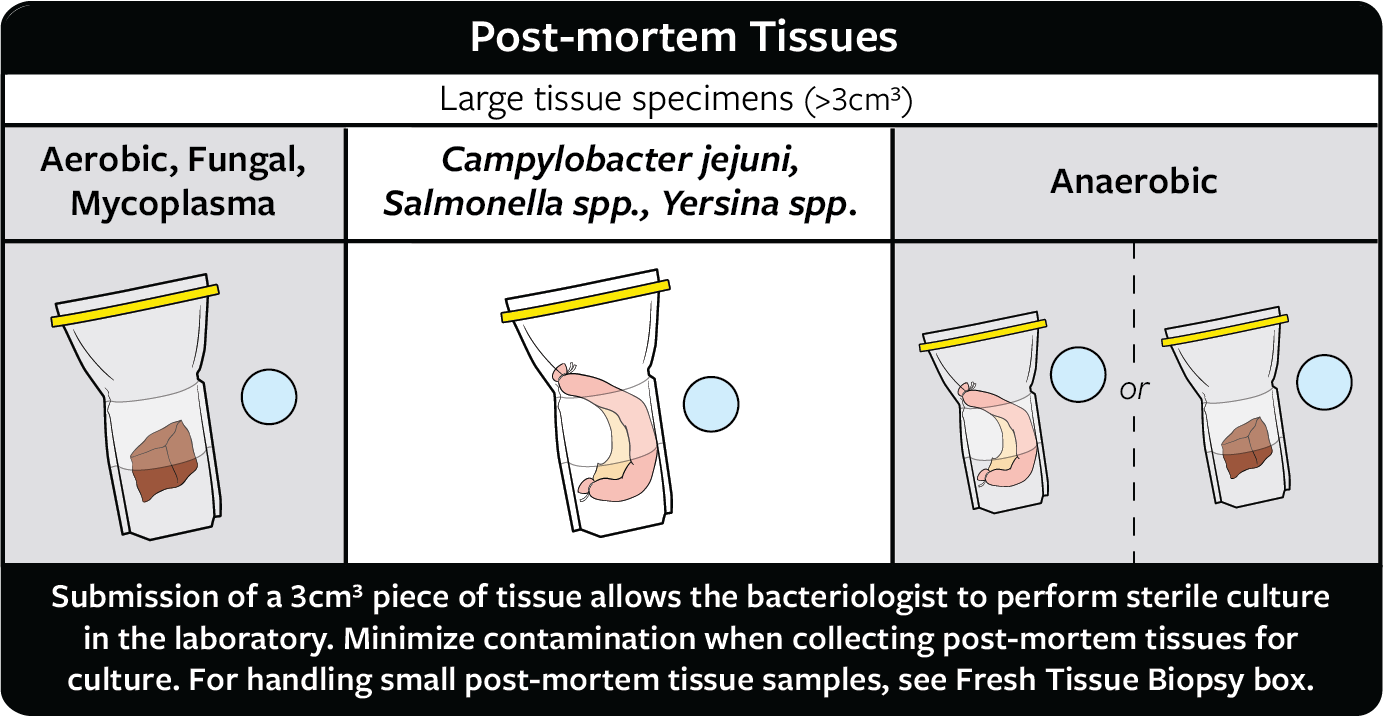
Illustration showing how to collect and store post-mortem tissue specimens (large tissue pieces greater than 3 cm³) for culture, divided into three sections: “Aerobic, Fungal, Mycoplasma,” “Campylobacter jejuni, Salmonella spp., Yersinia spp.,” and “Anaerobic.” A key indicates that a light blue circle means refrigerate and an orange circle with darker orange dots means store at room temperature. Container icons show sealed, leak-proof bags containing either a chunk of tissue or a tied-off loop of bowel.
For aerobic, fungal, and Mycoplasma testing: submit a chunk of tissue (>3 cm³) in a sealed, leak-proof container and refrigerate.
For Campylobacter jejuni, Salmonella, and Yersinia: submit a tied-off loop of bowel in a sealed, leak-proof container and refrigerate.
For anaerobic culture: submit either a tied-off loop of bowel or a chunk of tissue in a sealed, leak-proof container and refrigerate.
Footer text: Submitting a tissue piece of at least 3 cm³ allows the laboratory to perform sterile culture. Minimize contamination during collection of post-mortem tissues. For small post-mortem samples, refer to fresh tissue biopsy handling instructions.
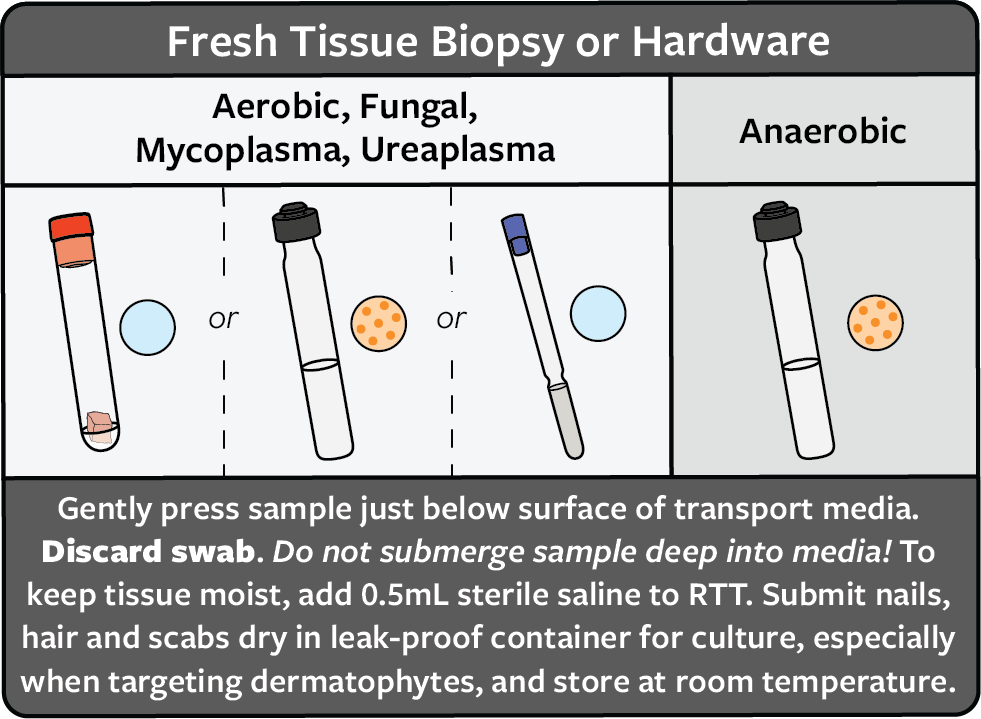
Illustration showing how to collect and store fresh tissue biopsy or hardware for culture, divided into two sections: “Aerobic, Fungal, Mycoplasma, Ureaplasma” and “Anaerobic.” A key indicates that a light blue circle means refrigerate and an orange circle with darker orange dots means store at room temperature. Container icons identify a red top tube (RTT), anaerobic transport tube, and aerobic transport swab.
For aerobic, fungal, Mycoplasma, and Ureaplasma testing: submit tissue in either a red top tube (refrigerated), anaerobic transport media (room temperature), or aerobic transport media (refrigerated).
For anaerobic culture: submit tissue in anaerobic transport media stored at room temperature.
Instructions: Gently press the tissue sample just below the surface of transport media and discard the swab; do not submerge the sample deeply into the media. To keep tissue moist, add about 0.5 mL sterile saline to the red top tube. Nails, hair, and scabs should be submitted dry in a leak-proof container for culture, especially when testing for dermatophytes, and stored at room temperature.
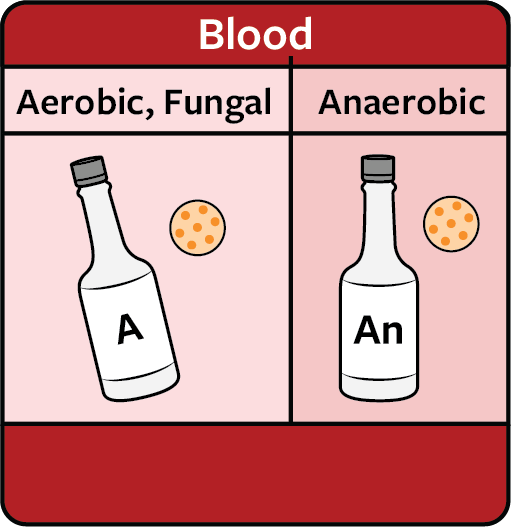
Illustration showing how to handle a blood sample for culture. The image is divided into two sections under the heading “Blood.” The left side is labeled “Aerobic, Fungal” and shows a blood culture bottle marked “A.” The right side is labeled “Anaerobic” and shows a bottle marked “An.” Next to each bottle is an orange circle with brighter orange dots, indicating that both types of blood culture samples should be stored at room temperature.
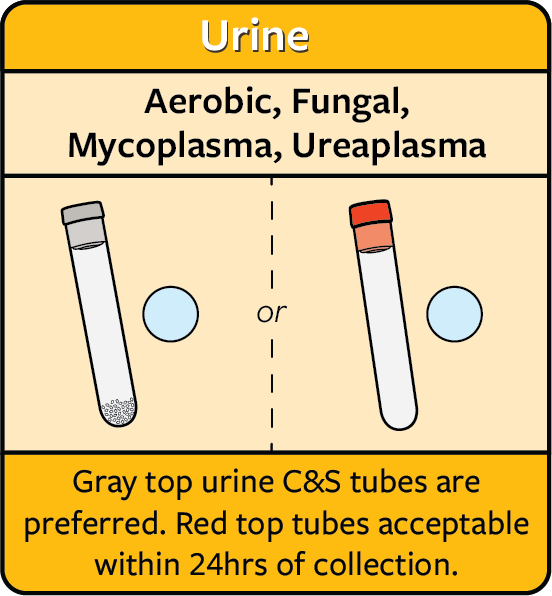
Illustration showing how to collect and store urine for culture under “Aerobic, Fungal, Mycoplasma, Ureaplasma.” A key indicates that a light blue circle means refrigerate and an orange circle with darker orange dots means store at room temperature. Container icons identify a gray top C&S urine tube (to prevent bacterial overgrowth) and a red top tube (RTT).
Submit urine in either a gray top C&S tube (preferred) or a red top tube; both should be stored refrigerated.
Footer text: Gray top urine C&S tubes are preferred. Red top tubes are acceptable if received within 24 hours of collection.
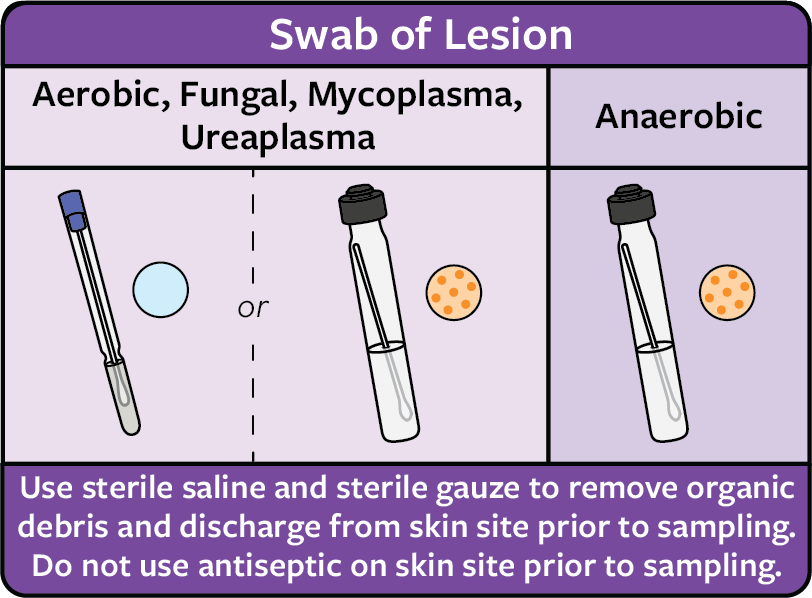
Instructions for sending in a swab of a lesion, containing two sections. The first section is for aerobic, fungal, mycoplasma, and ureaplasma lesion swabs. Those specimens can be sent using aerobic transport media, which should be refrigerated, or anaerobic transport media, which should be kept at room temperature.
The second section is for anaerobic lesion swabs. Those specimens can be sent using anaerobic transport media and kept at room temperature.
Illustration showing how to collect and store lesion swabs for culture, divided into two sections: “Aerobic, Fungal, Mycoplasma, Ureaplasma” and “Anaerobic.” A key indicates that a light blue circle means refrigerate and an orange circle with darker orange dots means store at room temperature. Container icons identify swabs in aerobic transport media and swabs in anaerobic transport media.
A caption at the bottom of the image reads: Use sterile saline and sterile gauze to remove organic debris and discharge from skin site prior to sampling. Do not use antiseptic on skin site prior to sampling.
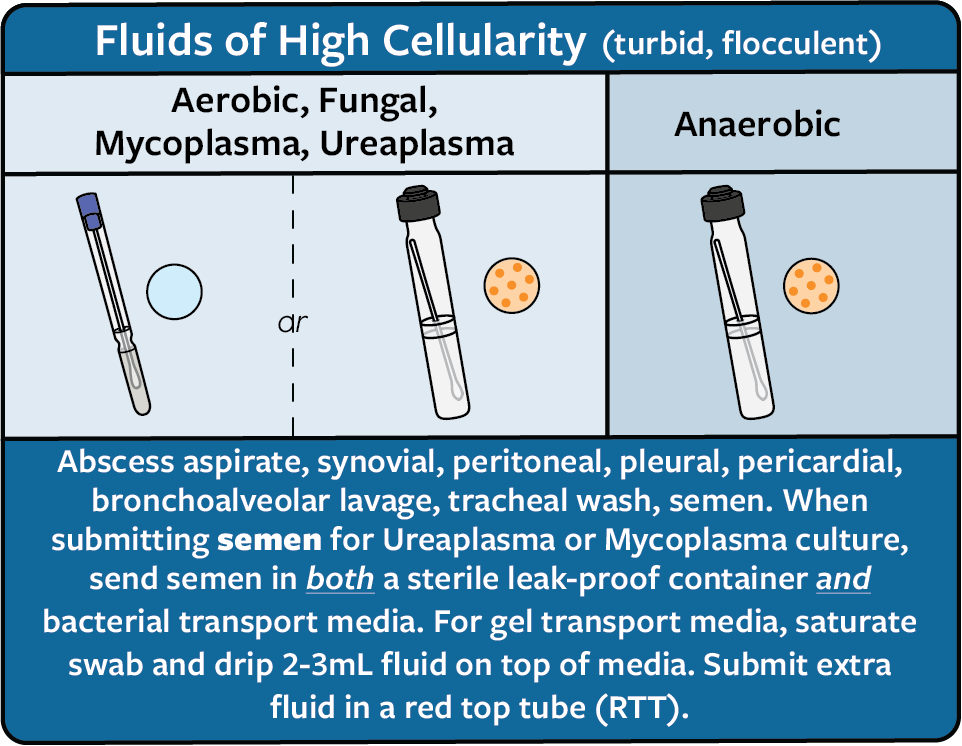
Illustration showing how to collect and store fluids of high cellularity (turbid, flocculent) for culture, divided into two sections: “Aerobic, Fungal, Mycoplasma, Ureaplasma” and “Anaerobic.” A key indicates that a light blue circle means refrigerate and an orange circle with darker orange dots means store at room temperature. Container icons identify swabs in aerobic transport media and swabs in anaerobic transport media.
For aerobic, fungal, Mycoplasma, and Ureaplasma testing: submit fluid using a saturated swab in aerobic transport swab stored refrigerated or a saturated swab in anaerobic transport media stored at room temperature.
For anaerobic culture: submit a saturated swab in anaerobic transport stored at room temperature.
Footer text lists acceptable specimen types: abscess aspirate, synovial, peritoneal, pleural, pericardial, bronchoalveolar lavage, tracheal wash, and semen. For Ureaplasma or Mycoplasma culture from semen, submit both a sterile leak-proof container and bacterial transport media. For gel transport media, saturate the swab and add 2–3 mL of fluid on top. Also submit extra fluid in a red top tube (RTT).
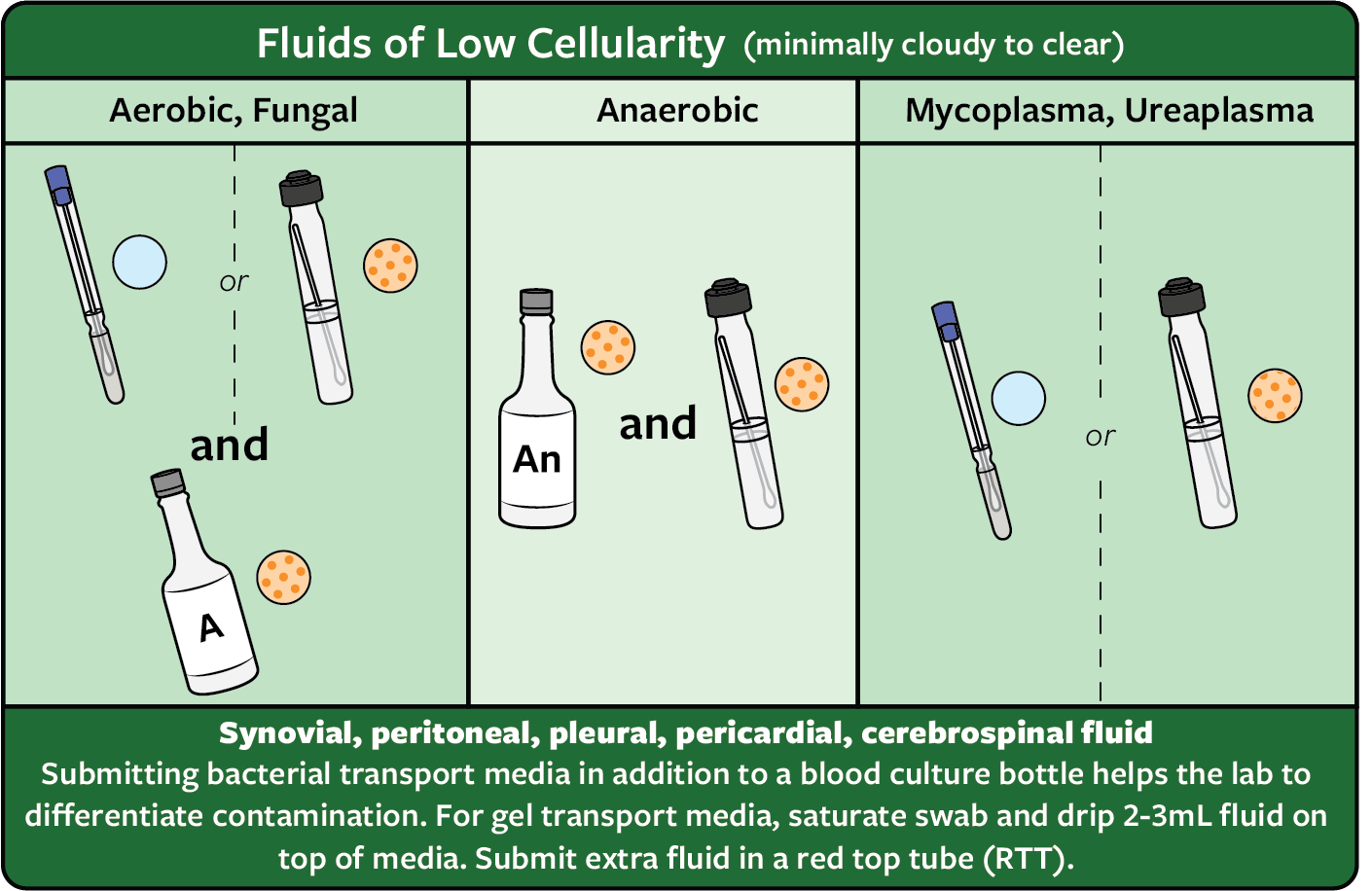
Illustration showing how to collect and store fluids of low cellularity (minimally cloudy to clear) for culture, divided into three sections: “Aerobic, Fungal,” “Anaerobic,” and “Mycoplasma, Ureaplasma.” A key indicates that a light blue circle means refrigerate and an orange circle with darker orange dots means store at room temperature. Container icons identify aerobic transport swabs, anaerobic transport tubes, and blood culture bottles (aerobic “A” and anaerobic “An”).
For aerobic and fungal testing: submit fluid using either a saturated swab in aerobic transport media (refrigerated) or a saturated swab in anaerobic transport tube (room temperature), and also submit an aerobic blood culture bottle stored at room temperature.
For anaerobic culture: submit both an anaerobic blood culture bottle and a saturated swab in anaerobic transport media, both stored at room temperature.
For Mycoplasma and Ureaplasma: submit fluid using either a saturated swab in aerobic transport media (refrigerated) or a saturated swab in anaerobic transport media (room temperature).
Footer text lists acceptable specimen types: synovial, peritoneal, pleural, pericardial, and cerebrospinal fluid. Submitting bacterial transport media in addition to a blood culture bottle helps the lab differentiate contamination. For gel transport media, saturate the swab and add 2–3 mL of fluid on top. Submit extra fluid in a red top tube (RTT).