This residency program provides three years of rigorous specialty training under the guidance of several board-certified clinical pathologists.
Program Highlights
We train residents to be outstanding clinical pathologists, well-versed in all aspects of clinical pathology, including hematopathology, cytopathology, clinical chemistry, laboratory management and applied clinical pathology research.
Training emphasizes principles of pathophysiology and mechanisms of disease, interpretation of laboratory data (including serum protein electrophoresis and flow cytometry), development of hematologic and cytologic diagnostic skills, and principles and techniques of laboratory methods.
These goals are accomplished through regularly scheduled resident training sessions, time spent on service, and self-study.
We follow training guidelines endorsed by the American Society of Veterinary Clinical Pathology (ASVCP) and American College of Veterinary Pathologists (ACVP), offering a well-rounded preparation for the board certification examination in clinical pathology by the ACVP.
Learning environment
Embedded in the rich and vibrant veterinary community at Cornell, our learning environment encourages scientific curiosity, critical thinking and offer residents a wide variety of learning opportunities. Training is organized around four main pillars:
- Diagnostic Services: Residents participate in diagnostic service duties. Cornell has a high and diverse caseload, including submissions from Cornell’s small and large animal teaching hospitals, and wildlife clinic.
- Teaching: Residents take an active role in clinical pathology instruction to veterinary students.
- Research: Residents design and carry out a hypothesis-driven clinical pathology research project, write a brief grant proposal, and present and publish their results, under guidance and mentoring by our faculty. Publication of case reports is also encouraged.
- Seminars and Rounds: These structured activities are designed to enhance diagnostic skills by providing resident with access to infrequent disorders, and assisting in preparation for the board certification examination by the ACVP. Residents also rotate through the Anatomic Pathology Laboratory’s surgical biopsy service and the Comparative Coagulation Laboratory.
Click to expand and learn more on our major areas of study during the residency is given below.
Diagnostic Service
Residents participate in daily cytology/hematology read-out sessions at least two weeks per month during the first two years of the program. In consultation with the pathologist on duty, residents review and prepare diagnostic reports for clinical cases submitted to the clinical pathology laboratory.
We have a rich and varied caseload from the Cornell University Hospital for Animals consisting of 73% small animals, 25% large animals and 2% exotics, in addition to a large number of cases submitted from national and international sources via the Animal Health Diagnostic Center.
Training is also provided on the performance and interpretation of specialized diagnostic testing, such as flow cytometry, protein electrophoresis, cytochemistry and immunocytochemistry. As the training progresses, residents are given increasing responsibility with the goal of independence (assuming full responsibility for laboratory results) during the final year of the program.
Teaching
Residents are involved in a variety of teaching activities, including:
- Leading small group teaching sessions for senior veterinary students
- Assisting in the organization and teaching of a comprehensive clinical pathology course.
- During the first and second year, residents assist in the preparation and delivery of laboratory session.
- During the second year of the program, residents are given the opportunity to take a more active role in clinical pathology instruction through didactic lectures.
- In the final year of the program, residents may also moderate large group discussions.
- Assisting in the organization and teaching of continuing education seminars offered at the College of Veterinary Medicine, such as the New York State Veterinary Conference.
Research
The resident will perform applied clinical pathologic-related research under the supervision of the clinical pathologists beginning in the first year of the program. Prospective, hypothesis-driven research is expected and will culminate in the publication of results in a peer-reviewed journal as well as presentation of results at the annual meeting of the ACVP.
During the course of their research, residents will acquire skills in study design, laboratory techniques and scientific writing. Residents are expected to write a Share the Future grant for the ACVP or apply for other funding opportunities. If available, residents are required to take a statistical course during their training program. Residents are also encouraged to publish individual case reports, submit mystery slide cases or case discussions for presentation at the annual meeting of the ACVP and participate in collaborative research with other members of the college community.
You can find information about research interests of the current faculty and research projects undertaken by current and previous residents below, in the Research Publications section.
Structured Activities, Seminars and Rounds
The residency training program is structured to allow residents to spend substantial time with all board-certified clinical pathologists. These structured activities are designed to give residents thorough training for success in a variety of career opportunities in clinical pathology by enhancing diagnostic skills, providing access to infrequent disorders that may not be encountered during the residency, and assisting in preparation for the board certification examination by the ACVP. These activities include:
- Weekly case seminars: Residents are given cytology, hematology, or surgical biopsy cases for description and interpretation. Starting in the second year, residents are encouraged to write a "board-style" description and interpretation.
- Biweekly or monthly chemistry case reviews: Residents are given clinical chemistry data for interpretation and critical discussion. Starting in the second year, residents are encouraged to write a "board-style" interpretation.
- Biweekly or monthly cytology-histology correlate sessions: Residents and faculty participate in the review and comparison of cytology and histopathology findings of cases, some of which are controversial and challenging.
- Biweekly seminars on special topics in clinical pathology: Each member of the clinical pathology team (residents and faculty) leads discussions, in rotation, on principles of clinical pathology. These seminars may include review of journal articles, methodologies, or other topics relating to laboratory medicine.
- Residents are encouraged to participate in a variety of other seminars and rounds held within the College of Veterinary Medicine (e.g. oncology rounds, infectious disease forums).
To facilitate training, residents have access to a wealth of archived resources that are available for directed and self-study. These resources include:
- An extensive textbook-based and online library.
- An extensive image database, including digitally scanned Aperio slides.
- PowerPoint presentations, lecture notes, and course notes from continuing education seminars held at Cornell University or obtained from other meetings
- Slide sets:
- Resident training slides (hematology, cytology, and surgical biopsy) that encompass interesting or challenging cases.
- Extensive archived hematology and chemistry slides from routine diagnostic evaluation including samples from normal tissues.
- Mystery slide sets with case summaries from ASVCP meetings (mystery slide cases, chemistry cases, case discussions).
- Examples of normal and abnormal results, including artifacts using the following techniques:
- ADVIA hematology analyzer
- Protein electrophoresis
- Flow cytometry
- Polymerase chain reaction for antigen receptor rearrangements
- Complete case material from interesting cases (representing all species)
Applications
The Department of Population Medicine and Diagnostic Sciences at Cornell University has a vacancy for a resident in Veterinary Clinical Pathology starting July 1, 2027.
The application deadline is Oct. 1, 2026. Only completed applications with all required materials will be considered.
Although offers may be made at any time after the application deadline, our program will abide by the ACVP training program network’s recommended universal acceptance date.
Who should apply?
A DVM/VMD or equivalent degree is required for consideration for this position.
Candidates with additional post-DVM experience (e.g. internship, clinical practice, masters, PhD) may be given preference but such experience is not a requirement.
Applicants from both foreign and American colleges of veterinary medicine are welcome to apply.
Materials
Applicants must submit:
A letter of intent, including a clear statement of career goals
Curriculum vitae
Veterinary school transcripts (electronic scans of official transcripts are acceptable)
Three letters of professional reference, sent to the email below directly by the referee
Electronic submission of application materials is preferred and should be sent to cpremail@cornell.edu.
TOEFL scores are NOT required for international applicants.
Compensation and Benefits
Beginning annual salary is approximately $51,000 plus benefits. Continuation in the program is contingent upon satisfactory annual performance evaluations.
Dental and health insurance is provided in addition to a retirement account, life insurance, and flexible spending accounts, as applicable, both at Cornell and the WCS. Benefit choices are selected at the time of hire, and employees pay for some or all of the elected choices.
Contacts and Questions
Julie Webb, DVM, Dipl. ACVP
Assistant Clinical Professor
Clinical Pathology Residency Director
Department of Population Medicine and Diagnostic Sciences
jlw444@cornell.edu
Clinical Pathology Team
Faculty
Current Residents
- Irene Alvarado Hidalgo
- Kate Marciano
- Laura Victoria Quishpe Contreras
Besides faculty and residents, our team also counts a laboratory manager, eight to 10 medical technologists, and two to three administrative assistants. We all work together to provide excellent service to our clients while maintaining a stimulating and fulfilling work environment.
Challenge Yourself!
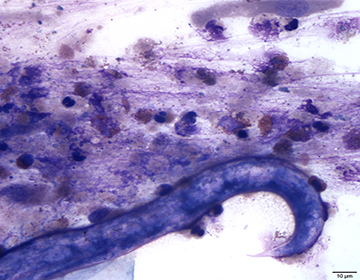
Review cases seen by Cornell University's Clinical Pathology Laboratory and test yourself with the questions and photomicrographs and make your own diagnosis!
Research publications
Research by Past Residents (since 1993)
- Shelley Chu, 2019-2022
- Jose Daniel Cruz Otero, 2015-2019
- Daniela Hernandez Muguiro, 2014-2018
- Midori Asakawa, 2013-2016
- What is your diagnosis? Cutaneous mass in a dog.
Asakawa MG, Lewis SM, Buckles EL, Stokol T.Vet Clin Pathol. 2015 Dec;44(4):607-8. doi: 10.1111/vcp.12280. Epub 2015 Aug 19.PMID: 26288379
- Ashleigh Newman, 2012-2015
- Reporting and interpreting red blood cell morphology: is there discordance between clinical pathologists and clinicians?
Newman AW, Rishniw M, Behling-Kelly E.Vet Clin Pathol. 2014 Dec;43(4):487-95. doi: 10.1111/vcp.12202. Epub 2014 Oct 3.PMID: 25280365 - Cholesteatoma and meningoencephalitis in a dog with chronic otitis externa.
Newman AW, Estey CM, McDonough S, Cerda-Gonzalez S, Larsen M, Stokol T.Vet Clin Pathol. 2015 Mar;44(1):157-63. doi: 10.1111/vcp.12212. Epub 2014 Nov 10.PMID: 25385218
- Erika Gruber, 2010-2013
- Role of tissue factor expression in thrombin generation by canine tumor cells.
Gruber EJ, Catalfamo JL, Stokol T.Am J Vet Res. 2016 Apr;77(4):404-12. doi: 10.2460/ajvr.77.4.404.PMID: 27027841
- Nora Springer, 2009-2012
- Flow cytometric detection of circulating platelet-derived microparticles in healthy adult horses.
Springer NL, Smith E, Brooks MB, Stokol T.Am J Vet Res. 2014 Oct;75(10):879-85. doi: 10.2460/ajvr.75.10.879.PMID: 25255176
- Seigo Ogasawara, 2007-2010
- Effect of recombinant canine interleukin-6 and interleukin-8 on tissue factor procoagulant activity in canine peripheral blood mononuclear cells and purified canine monocytes.
Ogasawara S, Daddona JL, Trimpert J, Stokol T.Vet Clin Pathol. 2012 Sep;41(3):325-35. doi: 10.1111/j.1939-165X.2012.00437.x. Epub 2012 Jun 21.PMID: 22724392 - Interleukin-10 inhibits lipopolysaccharide-induced upregulation of tissue factor in canine peripheral blood monocytes.
Ogasawara S, Stokol T.Vet Immunol Immunopathol. 2012 Aug 15;148(3-4):331-6. doi: 10.1016/j.vetimm.2012.04.023. Epub 2012 May 3.PMID: 22609246
- Heather Priest, 2006-2009
- Transferrin receptor expression in canine lymphoma.
Priest H, McDonough S, Erb H, Daddona J, Stokol T.Vet Pathol. 2011 Mar;48(2):466-74. doi: 10.1177/0300985810377074. Epub 2010 Aug 4.PMID: 20685917
- Amy Warren, 2006-2007
- Warren A, Stokol T, Hecker K, Nydam DV (2013) Storage-associated changes in the bovine hemogram with the ADVIA 120 hematology analyzer. Comp Clin Pathol. 22:1235-1240.
- Chris Mesher, 1993-1996
- Alanine aminotransferase apoenzyme in dogs.
Mesher CI, Rej R, Stokol T.Vet Clin Pathol. 1998;27(1):26-30. doi: 10.1111/j.1939-165x.1998.tb01076.x.PMID: 12075557 - What is your diagnosis? Subcutaneous nodule from a 14-month-old cat.
Mesher CI.Vet Clin Pathol. 1997;26(1):4. doi: 10.1111/j.1939-165x.1997.tb00688.x.PMID: 12658602 No abstract available. - What is your diagnosis? Liver impression smears from 5 juvenile canaries.
Mesher CI, Mauldin EA.Vet Clin Pathol. 1996;25(4):140. doi: 10.1111/j.1939-165x.1996.tb00987.x.PMID: 12660961 No abstract available. - Intracellular myelin in cerebrospinal fluid from a dog with myelomalacia.
Mesher CI, Blue JT, Guffroy MR, De Lahunta A.Vet Clin Pathol. 1996;25(4):124-126. doi: 10.1111/j.1939-165x.1996.tb00981.x.PMID: 12660957
Guidelines from the Education Committee of the American Society for Veterinary Clinical Pathology