


History
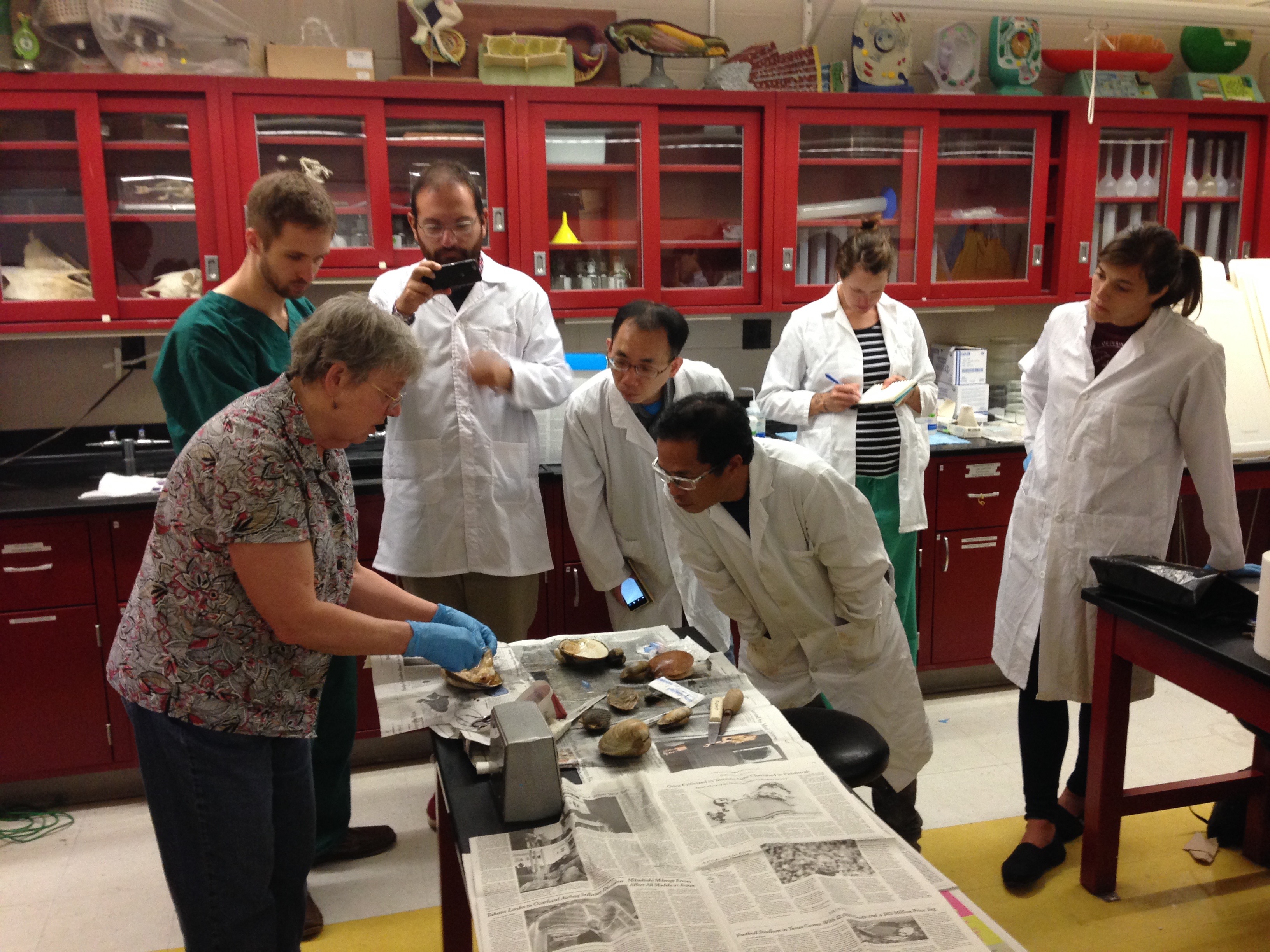
Although originally based at Penn, the concept of AQUAVET® grew out of discussions held in 1976 with many individuals at a variety of academic and research institutions. The underlying goal of AQUAVET® was the establishment of aquatic animal medicine as a functional specialty within the profession. Cornell became a partner at the beginning, and the program moved to Cornell in 2014. The courses have been presented every year since that first class in 1977.
Attempts to apply veterinary skills and knowledge to such an enormous range of invertebrate and vertebrate species requires unusual levels of student‑faculty interaction. Thus, the introductory course enjoyed the unusual feature of having close to 50 faculty for 32 students. Today, the ratio faculty to student is about 50 to 24.
Members of the veterinary medical profession have increasingly expressed a desire to contribute to the welfare of the inhabitants of the aquatic world. Furthermore, excessive harvesting, ever more significant pollution problems, and disease have had devastating effects on many sea animal populations, once taken for granted. In a protein-hungry world, control and prevention of disease among aquatic animals, especially those cultured for human consumption, is crucial. The biomedical skills used so effectively by veterinarians to deal with disease and increase productivity among terrestrial animals can be applied to aquatic animals as well. But this is possible only if schools of veterinary medicine develop programs to train students and stimulate research in aquatic animal medicine.
In 1983, the first AQUAVET®II course was offered. Attended by six individuals, most of whom were alumni of AQUAVET®I, the course lasted four weeks and served to augment the introductory course by covering, in greater detail, subjects in mariculture, toxicology, nutrition, and diseases of cultured fish.
In 2010 a new course was created: AQUAVET®III – Clinical Aspects of Captive Aquatic Animal Medicine. The course was designed for veterinary students and veterinarians who have specific interest in working in an aquarium or dolphinarium. The course was presented in three different venues. The first two weeks were focused on all of the animals found in a typical aquarium and was held at the Georgia Aquarium in Atlanta, GA. The next week focused on endoscopy and surgery of reptiles and fish taking place at the University of Georgia. The final two weeks took place at Dolphinaris in Cancún, México, where students focused on dolphin medicine including learning to take and analyze samples and hands-on learning of dolphin ultrasound and endoscopy. The pandemic caused this course to be discontinued.
AQUAVET’s original home/venue was at the Marine Biological Laboratory (MBL), Woods Hole, Massachusetts from 1977 to 2009. A major renovation project of MBL’s Loeb Building (lab) led the Directors of AQUAVET® to identify new facilities for the presentation of the 2010 Program. In 2010 the AQUAVET® Program was held at the Stony Brook Southampton campus in Southampton, New York on the eastern end of Long Island. The Southampton campus was closed by Stony Brook University in 2010 and was not available for 2011. The Directors then found a new excellent location to present the 2011 AQUAVET® Program. Since 2011, it has been held on the campus of Roger Williams University, in Bristol Rhode Island.
Over time, AQUAVET® has become well established and accepted within the profession, and many of its over 1500 alumni have pursued careers in aquatic animal medicine. After 50 years, AQUAVET® is apparently the oldest organization still teaching aquatic animal medicine. The goal is to provide for the orderly progression of students into positions of leadership, from which the real contributions of the profession can be made to society. The generation and application of new knowledge must be the ultimate mission.