



PATh PDX/CDX & Surgical Facility
The Progressive Assessment of Therapeutics (PATh) PDX Facility was established to provide comprehensive services and facilities to further the development and characterization of patient-derived xenograft (PDX) cancer models. PDX models using the NOD.Cg-PrkdcscidIl2rgtm1Wjl/SzJ (NSG) immunodeficient mice provide the most clinically relevant tumor models, which faithfully recapitulate the original tumor histology, genetic profile, and response/resistance to therapy.
The advantages associated with PDX mouse models include:
- Ability to more easily establish novel tumor lines (Human, Canine, etc...)
- Ability to test drug sensitivity in an in vivo model
- Simple subcutaneous engrafting technique
- Improved predictability of treatment outcomes and prognosis
- Potential applications in personalized precision medical treatments
- Ease of access to the subcutaneous tumor for biopsy
- Preserved tumor heterogeneity
- Allows for effective chronological tumor size monitoring
The PATh program operates on a cost recovery model, which allows us to pass on significant savings to the end user (you), some of which include animal costs and MR imaging time. PATh services are available to all Cornell and Weill Cornell investigators, outside institutions, industry, and private organizations.
The Facility Infrastructure
Our facility has extensive infrastructure to provide our clients with a full array of services ranging from the delivery of NSG mice to helping design and run preclinical trials with MR imaging. We operate three independent research rooms behind the barrier on the 2nd floor of the East Campus Research Facility (ECRF): an animal breeding colony of NSG mice, an experimental procedure room, and an MRI suite.
Facility Services
Surgical Services
While PATh’s chief purpose is to provide a comprehensive pre-clinical platform to reliably develop cancer models and test novel therapeutics, we understand that there may not always be a need for all the services that are offered. Therefore, we also offer our PDX services in an a la carte fashion. Second, the PATh facility has over twenty years of small animal surgical experience with a wide variety of expertise. Listed below are some of the core competencies that PATh can perform along with a willingness to try novel procedures that may be necessary to complete experiments. Budgets for surgical procedures can be created after a consultation to discuss investigator needs.
Telemeter Implantation
- Carotid placement
- Femoral placement
- Abdominal aorta placement
- Intraperitoneal placement
Brain Surgeries
- Injection of virus (Ad, AAV, Lenti) to specific regions
- Placement of cannula
General Procedures & Surgeries
- Osmotic pump implantation (subQ or IP)
- Ovariectomy
- Vasectomy
- Myocardial infarction
- Intravenous infusion
- Tail vein, subcutaneous, Intraperitoneal, Intramuscular injections
- Simple metabolic cages (water intake, urine collection, food consumption)
Other Services
Project planning and management
We will work with our client to create an individualized project plan for their proposed xenograft work. We will establish the proper roles/responsibilities for each of the facility staff and the deliverables our clients are responsible for to compete the necessary work. We will work closely with our client to help design a study that will meet their budgeting and time related needs.
Tissue/cell implantation
We will implant tissue or cell line samples based on client specifications. We can perform routine engraftment strategies such as subcutaneous implantation, and orthotopic models as well. Any procedure that we have not attempted previously will require a feasibility study to investigate the probability of success.
Post engraftment characterization/study
Based upon the project planning and experimental design consultation we will execute all commonly performed post engraftment procedures including but not limited to tumor growth monitoring, compound/drug delivery, and tumor harvesting.
Tissue/Cell Implantation
- Primary tumor implantation
- Tumor passaging
- Subcutaneous
- Intravenous
- Orthotopic models
Drug/Compound Delivery
- Common routes of administration: PO, IV, IP, IM
- Flexible dosing schedules
Tumor monitoring
- Caliper Measurements
- High Resolution MR Imaging
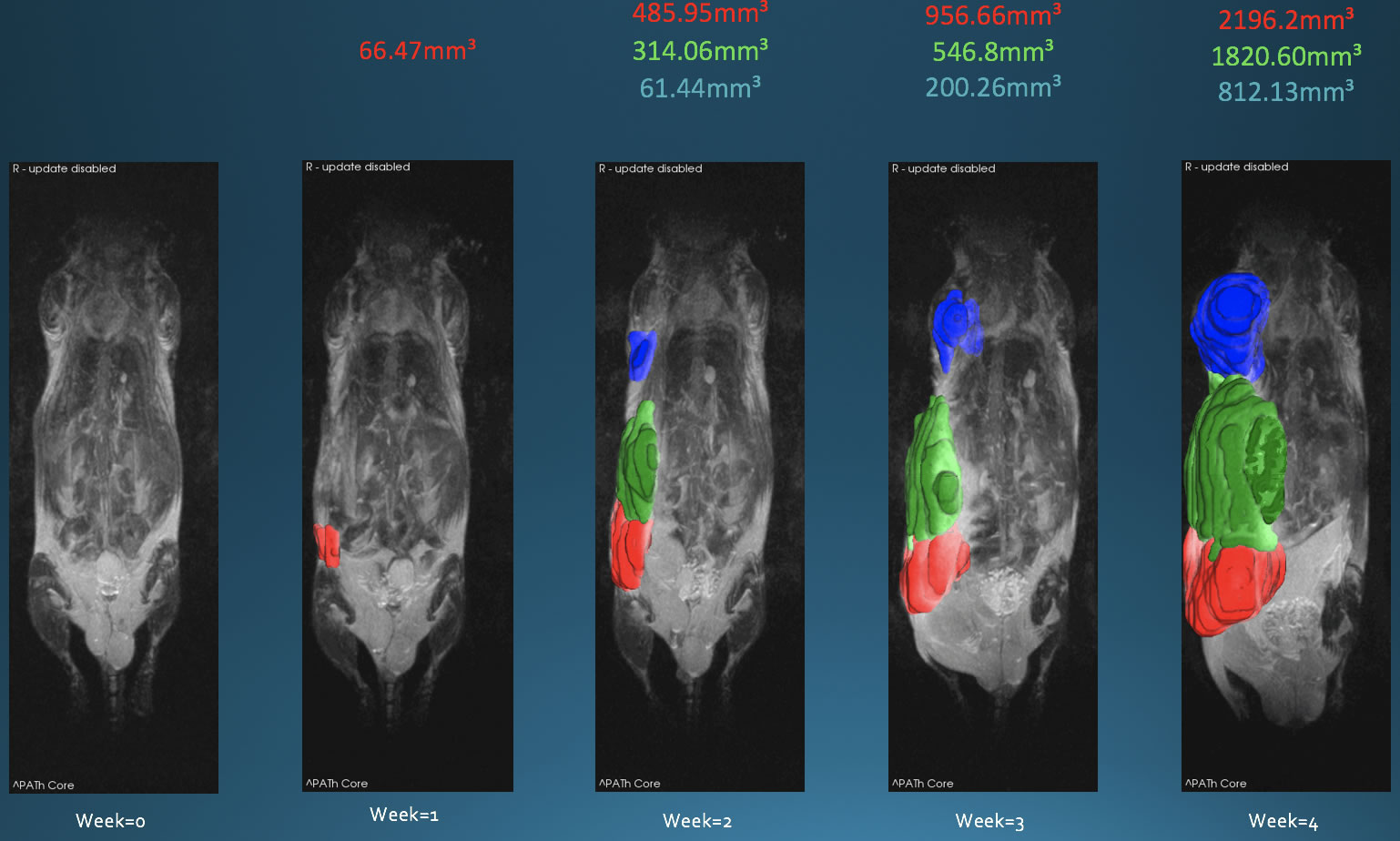
- Volumetric analyses using Invicro Autoquant image analysis software (see Fig. 1 below)
Tissue Collection
- Tumor/Organ collection, flash frozen in LN2 or formalin fixed
- Terminal bleeds
Using the Facility
Publications
Contact Us
Rishi Puri
PATh Project Manager
Department of Biomedical and Translational Sciences
T8 010 Veterinary Research Tower
College of Veterinary Medicine
Cornell University
Ithaca, New York 14853
e. rp422@cornell.edu